
|
|
Also - please look over the reading, Gang Leader for a Day Introduction and be ready to discuss it.
HW: Read Joel Charon's Should We Generalize?
Venkatesh's Gang Leader for a Day
Thoughts on the reading?
 |
| Here is a view of the complex of Robert Taylor Homes, a CHA project that used to be near U of Chicago. It was 28 buildings along a two-mile stretch designed for 11,000 people but peaked at 27,000 residents, of which 95% were unemployed and 96% were black. |
Today's lesson will focus on how sociologists actually do the work that they publish about. Venkatesh highlights a number of different ways that sociologists examine society. We will use his introduction to dive into how sociologists do research.

Interviews - questions that are open-ended.
Field work/ethnography - observing subjects by living with them, watching them and taking notes, such as Nicole Gonzalez Van Cleve's research about the Cook County Courthouse System.
Historical analysis - examing changes over time in comparison to present day.
Content Analysis - examining the content of media or other cultural productions
Here is an example of content analysis about climate change.
Survey - questionnaires that are close-ended such as multiple choice or likert scale.
Experiment/Audit study - comparing the responses of two or more different reactions.
Statistical analysis - existing sources (data sets, such as GSS or Census data)
Jacob Farber from NYU explains his research based on existing data here in his study titled "Complaining while Black"
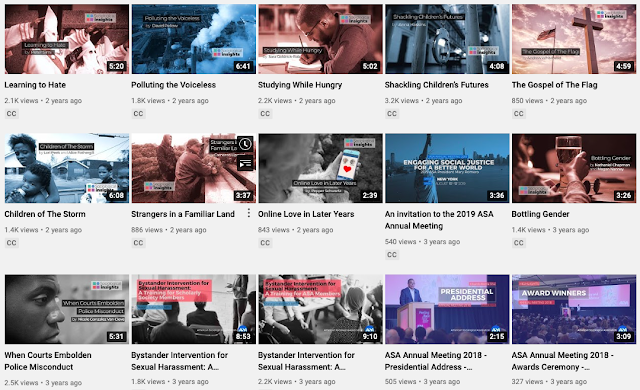
There are many data sets available to sociologists and other researchers. This type of research involves examining the data in new ways. Here is a list of data sets that are often used by sociologists:

HW: Read Joel Charon's Should We Generalize?

The Office of Global and Community Engagement is excited to offer another webinar in its What are we Learning from the War in Ukraine? series.
Please join us on February 15h at 12PM CST for a presentation titled The War in Ukraine and US Foreign Policy. Alexandru Grigorescu, PhD, Professor and Chair of the Political Science Department and Director of CRIA at Loyola University Chicago will lead a conversation that explores how US foreign policies have been altered over the past year due to the war in Ukraine. Ryan Guirlinger, Ukraine Political Unit Chief in the Office of Eastern European Affairs at the U.S. Department of State, will join Dr. Grigorescu.
You can register for the webinar here. More information about other discussions in this series can be found on The Office of Global and Community Engagement’s website.
· overgeneralization - basing all of your understanding on a limited experience.· selective observation/confirmation bias - seeking out only evidence that supports your opinion.· premature closure - deciding on a conclusion and then being unable to see evidence contrary to that conclusion.· halo effect - having a positive view of one aspect of a person or idea and that affects your view of all other aspects associated with it.· false consensus - the tendency to overestimate how much others agree with us.
Don't let the length of the journal article intimidate you, nor should you be intimidated by the loquaciousness of the author's writing. Academic professors often use fancy jargon (like loquaciousness). It makes the reading longer and sometimes confusing, but you can still understand what the researcher is getting at. Especially if you understand the structure that I explain below. Here is a funny example of how writing gets more complicated even though it says the same idea:

Simply put - read through the jargon and decipher what you can. If necessary, look up the words you need to know to understand the main point, but don't be intimidated by the length or the wording of the article.
B. Understand the structure
Most of the research articles have a similar structure. Once you understand the structure, it is easier to find what you need and make sense of the article. Sometimes these sections will even be labeled for you.
Most research articles have a format that looks like this: (sometimes a couple of these sections are combined)
Understanding the structure I explained in B above should help you understand the research efficiently and bounce around the article to find what you are looking for.
1. ASA journals
The most recent research in a number of journals is available online for free from the American Sociological Association. The journals page on the ASA website lists the journals along with a description of what is published in them. The journals page is here: https://www.asanet.org/publications/journals/
The most useful journals for our class are the following:
American Sociological Review, ASA’s flagship journal, includes the latest general interest scholarship in sociology that advances our understanding of fundamental social processes through theoretical, methodological, and empirical innovation.
City & Community, a journal of the ASA Section on Community and Urban Sociology, aims to advance urban sociological theory, promote empirical research on communities and urban social life, and encourage sociological perspectives on urban policy.
Journal of Health and Social Behavior publishes empirical and theoretical articles that apply sociological concepts and methods to the understanding of health and illness and the organization of medicine and health care.
Journal of World-Systems Research, an open access, online-only journal of the ASA Section on Political Economy of the World-System, publishes research on topics that are relevant to the analysis of world-systems.
Social Psychology Quarterly publishes theoretical and empirical work on the link between the individual and society, including the study of the relations of individuals to one another, as well as to groups, collectivities, and institutions.
Society and Mental Health, a journal of the ASA Section on Sociology of Mental Health, publishes articles that apply sociological concepts and methods to the understanding of the social origins of mental health and illness, the social consequences for persons with mental illness, and the organization and financing of mental health services and care.
Sociology of Education publishes research that examines how social institutions and individuals’ experiences within these institutions affect educational processes and social development.
Sociology of Race and Ethnicity, a journal of the ASA Section on Racial and Ethnic Minorities, publishes sociological research on race and ethnicity across epistemological, methodological, and theoretical orientations.
Socius: Sociological Research for a Dynamic World provides an open access online-only forum for rapid publication of sociological research from any subfield of the discipline.
2. JSTOR
Once journals are a few years old, they are stored in a searchable, online archive called JSTOR. The limitation for JSTOR is that the articles are older, but the benefits are that the archive will search dozens of journals for you and you can target the search by key words or author, etc...
Here is how to search JSTOR:

Key Words - Type in the key words/topics that you would like to search. Try different search terms using synonyms such as "school" in one search then "education" in another search.
Narrow Results - Select only "articles" in the filtering menu on the left side - so you don't get results from reviews or book chapters.
Journal Filter - Scroll down to select "sociology" under search by subject. That will limit your search to only journals that are sociological.
Additional tips for finding research - open a few different articles that are possibilities then try different search terms and open more. This might help you find the most relevant articles before you waste time reading one less relevant; quickly read the abstract or introduction to decide if the article is worth looking at in greater detail; start out with a search for general terms then you can narrow down by adding other terms or dates; if you find an interesting secondary source (such as from our previous lesson), note who the researcher was and try searching for their last name.
The Sociological Perspective
Assessment
For this first unit, we have been learning about the sociological perspective. We learned about a few different theories: Peter Berger’s Social Construction of Reality and C. Wright Mills’ Sociological Imagination, and we learned about the foundational sociological paradigms: Durkheim’s Structural-Functional, Marx’s Conflict, and Symbolic-Interaction. I want you to demonstrate your understanding of the sociological perspective by writing an authentic essay that shows your ability to apply the sociological perspective to your own life.
Instructions/Prompt:
Write an original essay that both explains the sociological perspective and applies it uniquely to experiences from your own life. Your essay should include a discussion of at least three of either the theories or paradigms that are italicized above and include unique examples of how each of the theories or paradigms apply authentically to your own life. To be authentic, your example should apply uniquely to you – it should not be able to be applied to anyone else from our class. Be specific and detailed. One example of authenticity is the demographic sheet you filled out during our first lesson. All of those questions were unique to your lived experience. Other ideas for being authentic are embedded within each of the lessons we did – such as: your name, or your high school or your family, etc…
Turning in your work.
The essay is due by the start of our next class (Tuesday, Feb 7).
When you are finished with your essay, submit it here:
If you prefer to hand in your essay using a hard copy (actual paper) feel free to do so.
Grading:
Your grade will be out of 40 pts based on the following rubric:
Paradigm/Theory Choice #1 (out of 10 points)
10 Fully explained and accurate explanation of how the theory or paradigm connects to your own unique and authentic example(s).
8 Not completely explained or accurate.
7 Not authentic or original.
6 Incorrect explanation.
0 Not submitted or academically dishonest.
Paradigm/Theory Choice #2 (out of 10 points)
10 Fully explained and accurate explanation of how the theory or paradigm connects to your own unique and authentic example(s).
8 Not completely explained or accurate.
7 Not authentic or original.
6 Incorrect explanation.
0 Not submitted or academically dishonest.
Paradigm/Theory Choice #3 (out of 10 points)
10 Fully explained and accurate explanation of how the theory or paradigm connects to your own unique and authentic example(s).
8 Not completely explained or accurate.
7 Not authentic or original.
6 Incorrect explanation.
0 Not submitted or academically dishonest.
Writing (out of 10 points)
10 The writing was well organized and did not include any distracting misspellings or grammar.
One point less for each misspelling or grammar mistake that is a distraction to your essay.
5 The essay was turned in late.
0 The essay was not turned in.
Suggested Structure:
This is not required, but I suggest a structure that looks like this:
· Paragraph 1: An introduction of what the sociological perspective is in general.
· Paragraph 2: Explains one of the theories or paradigms and how it fits into the sociological perspective. Explain an authentic connection or example from your own life or experience.
· Paragraph 3: Explain a second theory or paradigm and how it fits into the sociological perspective. Explain an authentic connection or example from your own life or experience.
· Paragraph 4: Explain a third theory or paradigm and how it fits into the sociological perspective. Explain an authentic connection or example from your own life or experience.
Other tips:
Use a word processing app and save your work there first, Then when you are ready to submit, use the link to Google forms to submit your essay.
You may use first person (I and me). This is a less formal essay so that is fine.
If you are feeling uncertain about what to write, remember the point of this assessment is to simply explain that you know how sociologists look at the world and demonstrate that you can give a unique and authentic example. That's it - don't over think it!
If you have trouble, please do not fret alone.
Use Loyola’s writing center.
Email me at csalituro@luc.edu and we can communicate via email, zoom or make an appointment to meet in person.

