Thursday, September 18, 2025

1.08 Ingroups, Outgroups, Categories, Stereotypes and the importance of (critical) data

 While waiting, please review:

 Joel Charon's "Should We Generalize About People?"

 Joel Best's "The Truth about Damned Lies and Statistics.


Please sit in your designated areas.


GYM SHOES or                                                 NO Gym Shoes

SNEAKERS                                                       NO Sneakers

<-------                                                            ------->


In and out is not just for burgers, it is also for groups! Sociologists use the terms ingroup and outgroup to refer to groups that you are either a member of (ingroup) or not a member of (outgroup).


To illustrate this, today I separate the class into two different groups.   To put it another way, I create an ingroup and an outgroup for each student.  Each group made a list of reasons why the other group was in that outgroup. Every time I do this lesson, the reasons break down into judgments against the other group.

For example, in class I split students into 2 groups of students wearing spirit wear and those who were not. I asked each group to list as many answers as they could about the other group:
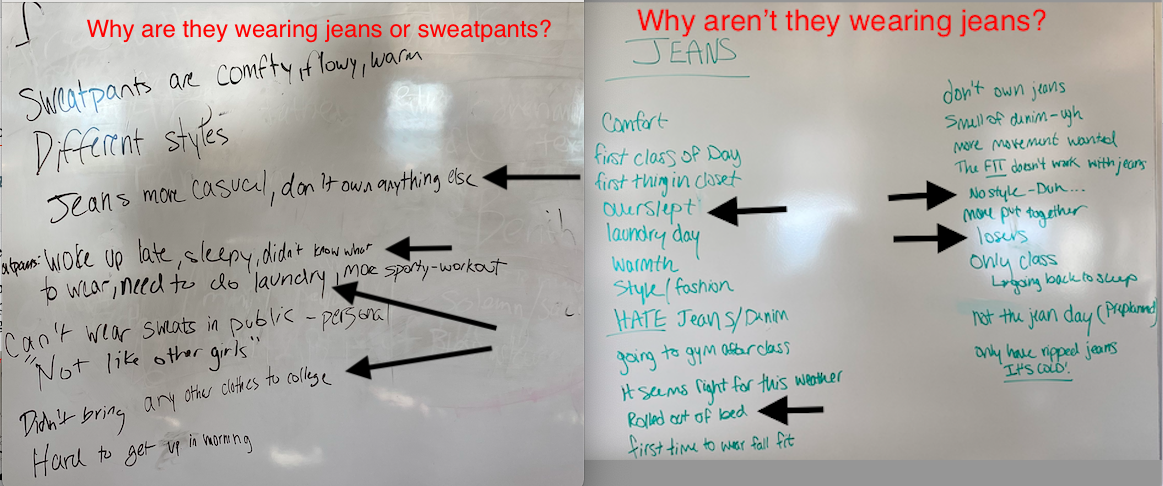


In just a few minutes, I created an in-group and an out-group.  


Importance of Understanding Ingroup-outgroup Dynamics


Ingroups are groups that an individual is in. You have membership in it, and because of that, you feel aligned to the group and you have ownership in it and you are more likely to trust it.  It is easier for individuals to recognize the diversity within their ingroups.

Out-groups, by contrast, are the groups that one is not a part of.  People tend to fear outgroups and judge them more than their own ingroups.  This can result in people unnecessarily fearing outgroups and scapegoating them.  They also tend to see outgroups as being less diverse and having less individuality/differences than those of an ingroup.  The tendency to view all members of an outgroup as similar is known as outgroup homogeneity.  Often, outgroups are based on a master status - a sociological term for a person's most salient group membership, or a group that defines the person to a society.

When I do this lesson, some years I divide students by who is wearing jeans, or who is wearing hoodies or who is wearing gym shoes.  Regardless of how arbitrary the groups are, a similar result happens:  students generalize about the other group and pass judgments.  This is a small example of what happens with ingroups and outgroups - imagine how much we are affected by the ingroups and outgroups that we experience from the time we are young.   


1.  What are some ingroups that you are a part of in your life?


Examples of how people can have fears and judgmental views of outgroups:


RACE
Jane Elliot's Brown Eyes/Blue Eyes illustrates racial outgroup attitudes
Jane Elliot, a teacher in the 1960s conducted an experiment in her third grade classroom to show the power of ingroups and outgroups.  
Here is a clip of her 1960s experiment:


And there is an updated version of this. Jane Elliot returns to do the experiment with college kids. Here is a 5 min clip.  And here is the whole video.

Here is Jane Elliot on Jimmy Fallon in 2021 talking about her experiment.


RELIGION:
Below is a link to a video called I am an American that shows the dangerous stereotypes that outgroup homogeneity led to in the wake of 9/11.  All of the audio is from real radio programs and it is juxtaposed on top of video of real Americans.

In this case, Islam is the example, but it could be any religion, ethnicity or group. United States' history is punctuated with examples of groups that have been scapegoated and vilified. This is how Muslims have been treated in many cases in post-911 America. For many Americans, Muslims are an outgrip and so Americans who don't know any Muslims easily fall prey to stereotyping/overgeneralizing them, judging them, fearing them.  But I have had so many Muslim students that I don't see them as an outgroup, nor do I see them with homogeneity, or a monolith.  And that is what this video is showing. There are caring, loving, neighborly Muslims all around us and they a diverse group of people, but when they are an outgrip, it is easy to not see these realities.  Here is a link to a page hoping to end stereotypes about Muslims.

In fact, in the wake of 9/11, many Muslims were stereotyped as terrorists and some were victims of vengeful hate crimes.  But because of outgroup homogeneity, the first person murdered as a hateful vengeance for 9/11 was not even Muslim or Arab - he was Sikh.  His name is Balbir Singh Sodhi   Here is his story on NPR's Story Corps.   And 15 years later, Sikhs are still being victimized.  But Sodhi's brother has made it his mission to preach forgiveness.


2017 Americans are afraid of Muslims especially after some people are scapegoating them:
http://www.nbcnews.com/news/us-news/psychology-hate-groups-what-drives-someone-join-one-n792941
Much of hate is based in fear, said Dr. A.J. Marsden, an assistant professor of psychology at Beacon College in Leesburg, Florida — "basically, fear of the unknown, fear of what might happen and fear of anything that's different than you or falls outside your definition of what's supposed to be normal."
"We establish ourselves as a tribe, and we say this is the group for which I have a love for, for which I identify with" Marsden cited Islamophobia as an example."There's a lot of hatred in the United States toward Muslims," she said. "One of the reasons is they don't understand the religion. ... There's a lot that they don't know, and that scares them, because there is a small part of Muslims who are violent, and that is what is driving the hate."
That concept is known as the "in-group/out-group theory" — the idea that people tend to define themselves in social groupings and are quick to degrade those who don't fit into those groups."

2017 Research about media coverage of Muslims affects outgroup Americans fears
http://www.wbur.org/npr/532963059/when-is-it-terrorism-how-the-media-covers-attacks-by-muslim-perpetrators
"New research from Erin Kearns and colleagues at Georgia State University shows that the president is right — sort of. There is a systematic bias in the way terrorism is covered — just not in the way the president thinks.
Kearns says the "terrorism" label is often only applied to cases where the perpetrator is Muslim. And, those cases also receive significantly more news coverage.
"When the perpetrator is Muslim, you can expect that attack to receive about four and a half times more media coverage than if the perpetrator was not Muslim," Kearns says. Put another way, "a perpetrator who is not Muslim would have to kill on average about seven more people to receive the same amount of coverage as a perpetrator who's Muslim."
Perhaps these findings are not all that surprising to you. But there are disturbing implications for the way Americans perceive Muslims, and the way Muslims perceive themselves."
Connecting research, ingroups-outgroups, mindfulness and the fear of guns v. terrorism
https://qz.com/898207/the-psychology-of-why-americans-are-more-scared-of-terrorism-than-guns-though-guns-are-3210-times-likelier-to-kill-them/
According to the New America Foundation, jihadists killed 94 people inside the United States between 2005 and 2015. During that same time period, 301,797 people in the US were shot dead, Politifact reports.  But... Americans are more afraid of terrorism than they are of guns, despite the fact that guns are 3,210 times more likely to kill them.
Chapman University has conducted a Survey of American Fears for more than three years. It asks 1,500 adults what they fear the most. It organizes the fears into categories that include personal fears, conspiracy theories, terrorism, natural disasters, paranormal fears, and more recently, fear of Muslims.
In 2016, Americans’ number-one fear was “corruption of government officials”—the same top fear as in 2015.  Terrorist attacks came second.  In fact, of the top five fears, two are terror-related.  And number five is not fear of guns but fear of government restrictions on guns.  Fear of a loved one dying—whether by gun violence or anything else—came next.
... after the terror attacks of Sept. 11, 2001, people began flying less and driving more. The result, estimated Gerd Gigerenzer, a German risk specialist, was that 1,595 more Americans died in road accidents during the 12 months after 9/11 than would have otherwise.  Michael Rothschild, then an emeritus professor at the University of Wisconsin, calculated some of the risks we face:
One in 6 million: Risk of dying in a plane hijacking, assuming you fly four times a month and hijackers destroy one plane every year. (Just to be clear, since 9/11, hijackers have not destroyed any flights in the US.)
One in 7,000: the risk of dying in a car accident in any given year
One in 600: the risk of dying from cancer in any given year
According to data compiled from the Centers for Disease Control, over 2005-2014, an average of 11,737 Americans a year were shot dead by another American (21 of them by toddlers), 737 were killed by falling out of bed, and nine were killed by Islamic jihadists—who in most cases were US citizens, not immigrants (Nearly twice as many Americans kill themselves with guns as kill each other).
In this example, the media and most Americans see terrorists as an outgroup and because some terrorists claimed to act in the name of Islam, Americans stereotype the category of Muslims into terrorist.  The fear, mistrust and stereotype result from most Americans seeing them as an outgroup.

The power of recognizing our own outgroups
I think that the point of sociological mindfulness is becoming more aware of others and part of that awareness is an understanding of how we may have portrayed that group in our own minds. So understanding the idea of in-group/out-group dynamics is easy but applying it to ourselves is the challenging part.  But when we recognize outgroups, we can be more mindful about how we think about them and question where our assumptions about them have come from.  And maybe most importantly, we can bridge these outgroups by getting to know people who are part of our outgroups.


The Power of Ingroups to Transform Society
Because social scientists know the power of ingroups, we can use that understanding to make a real difference in society.  This is one reason why a diverse campus matters and a diverse friend group matters.  


Stranger at the Gate is a 2022 short documentary that shows the power of both outgroups and conquering their dangerous consequences through our shared humanity.
Here is a PBS story about the movie.  Watch from :26 - 3:11


Former marine Richard "Mac" McKinney was determined to bomb the local Islamic center in Muncie, Indiana. But the kindness he was shown there not only made him drop his plans, but eventually become a member of the community. The story is told in the new short film "Stranger at the Gate,directed by Josh Seftel.

Former student of mine, Amina Amdeen
Here is a Muslim former student of mine, Amina Amdeen on NPR's Story Corps who makes me so proud.  Listen to her story about the danger of outgroups and how bridging the gap can bring people together.

Here is NPR's coverage of the story.


Transforming a white supremacist
This episode of On Being demonstrates how creating an ingroup can also create empathy.
"We'd heard Derek Black, the former white power heir apparent, interviewed before about his past. But never about the friendships, with other people in their twenties, that changed him. After his ideology was outed at college, one of the only orthodox Jews on campus invited Derek to Shabbat dinner. What happened over the next two years is like a roadmap for transforming some of the hardest territory of our time."
More about Black's transformation in the 2018 Pulitzer Prize winning book by Eli Saslow called Rising Out of Hatred.


Cubs Joe Maddon and The Creation of Ingroups and Empathy
Cubs Joe Maddon's "Hazelton Integration Project" is a great example of how creating ingroups can help people bridge outgroups like race, immigration status and social class.  Essentially Coach Maddon did what I did in class: He created ingroups.  Except, he did it to create bonds between people who would have previously identified each other as outgroups. Watch this short summary here about how Maddon's project helped to create a sense of community and ingroup relationships.


As this semester goes on, be mindful of the groups that we talk about that are your outgroups. You must make a conscious effort to understand these groups and recognize the diversity within these groups. 
Research is important in helping us understand the unique aspects of out groups that we may not be familiar with.  Additionally, it is important to recognize our own biases connected to our in-groups so that this does not affect the objectivity of our research.

2. Choose one of the examples above that you think is a good example of the importance of ingroups and outgroups.  Identify the two groups in the article. How does one of the groups judge/stereotype their outgroup?

3. Please share one or more examples from your own experience where you have had a misconception about an outgroup, but after getting to know someone from the outgroup, you had a new understanding of people from the group.


4.  Examine the research article that you found for this unit.  
Was the research focused on an ingroup or outgroup for you?   

5.  How might your research shed light on this group to avoid viewing the group with outgroup homogeneity?

Now think about your own life.  What are your in groups?  What are the outgroups that you could become more aware of, more empathetic to?


More on Ingroups and Outgroups:

Research on Ingroups and Middle School Cliques
Patricia and Peter Adler studied adolescents extensively and they concluded that the creation of cliques happens cyclically even before middle school begins and these can lead to prejudice and discrimination. Here is one of  Patricia and Peter Adler's ethnographies and you can read an excerpt from their conclusion below:


Joel Charon's "Should We Generalize About People?" and Ingroups-Outgroups


The difference between categories and stereotypes

6.  How is Charon's article "Should We Generalize?" related to understanding outgroups? What is the answer to "should we generalize?"


7. What is the difference between a generalization and a stereotype?


Examples of stereotypes about differently-abled individuals 


Brett Eastburn
Brett Eastburn was born with no arms or legs.  Here is an article in the Daily Herald about Eastburn visiting a school in Mt. Prospect.  We might categorize him as disabled, but we should be careful about the assumptions and stereotypes that go along with that category.  Here is a Ted Talk by Eastburn and here is his book, I'm Not Missing Anything


Nick Vujicic
Another powerful differently-abled speaker is Nick Vujicic. He is a motivational speaker who also has no limbs.   Here is a video of him on youtube


Aaron Fotheringham
This is a video about Aaron Fotheringham, an "extreme sitter." Aaron has been in a wheelchair his whole life, but he sees it as an opportunity. Again, we should be careful of our stereotypes. Aaron is way more rad than I will ever be, but he is in a wheelchair and I am not.  If you search youtube, you can see Aaron doing a double backflip! But there are also lots of videoes of him crashing over and over again and again. It takes hard work and lots of effort to become good at what you do.  

Hard work was a theme in all of the above videoes.  And if you read the rest of Outliers, Gladwell makes the case that the most successful people spend ten thousand hours developing their skills.  The other theme that comes out in all of these videoes from Brett Eastburn to Aaron Fotheringham is that in order to find meaning in your life you must find a way to serve others.  Find a way to help other people.  You have talents.  Develop them and find a way to use them to help others.  That is your purpose.  And here is Aaron "wheels" Fotheringham at the 2016 Paralympics:


Here is the latest update from Wheelz on the BBC
Here is a video about a different type of street performer that also challenges your assumptions about the category "disabled".


I love how these "disabled" people see their opportunity to teach others.  Their lessons seem to be similar:  The world doesn't owe you anything.  You owe yourself hard work and dedication to become what you want.  Find a way to help others/teach others.  Don't stereotype and keep an open mind.

Lessons from differently-abled individuals:
  • Accept yourself as a part of creation; your existence is the universe's confirmation to you that you matter.
  • Develop your talents/desires.  Whatever you want takes hard work. It takes failure, discomfort and effort.
  • Find ways to serve others.  Whenever you don't know what to do or when your life feels directionless or meaningless, find a way to serve others.  We all have talents that can help others.

8. What are the groups that are examined in the original research that you found? (Use the abstract)

9.  Does your researcher make any generalizations/conclusions about the group? (Use the abstract or conclusion)

10.  Does your researcher explain any nuances about the group that might help people from the outgroup think more critically about the group?


EXTRA:
Dealing with stereotypes
Finally, when you feel like you have been stereotyped, how do you react? What do you do? Anis Mojgani suggests that you shake the dust. Checkout his slam poemHere is a link to his poem in writing.


Lesson from Mojgani: When you have been stereotyped, shake the dust.  Move on and don't let the dust settle on you.  Don't let it define you.


The Cookie Thief, a poetic example of judging
There is a poem I like that illustrates Charon's point. The poem called "The Cookie Thief" by Valerie Cox. We are all cookie thieves sometimes in how we erroneously use the categories that Charon talks about. 

Lesson
We have all been both the victim of stereotyping and the perpetrator of it.  Try not to be the cookie thief.

This American Life, radio episode about stereotypes 
Another great source about stereotypes is episode 362 from This American Life. Click here to listen to the episode where 5 people tell stories about stereotyping. Listen to the prologue about people with disabilities, and Act One about NY cops stereotyping people coming from Brooklyn.


Data, Statistics and Research; Joel Best's Damned Lies and Statistics


Data and statistics can help us understand the groups we are studying better


11.  According to Best, what are the 2 harmful ways that people view statistics? 

12.  How does Best say people should view statistics? 

13.  Rather than viewing a statistic's flaws, how does Best say that people should be thoughtful about statistics? 


How to be critical of statistics/research:

Ask questions.
Operationalize terms - what are the words of the statistic referring to?
Don't just accept the data but ask where it came from.
Look for a section (usually at the end) called Discussion or Limitations;  usually, authors are critical of their own work.


Apply:  Best's reading to your own research.


Individually


14.  What statistics or claims are in the research that you found?  Apply some of Best's suggestions to statistics from your research article.


Like the video explains, research is rigorous and sometimes slow and tedious. It takes time and trials and analysis. Research doesn't lend itself to sweeping generalizations - it is usually more specific and targeted, nuanced.  Examining Statistics in Sociology (and generally) requires critical thinking.  By critical, I mean being detailed and inquisitive about the stats.  For example, let's examine the following claim that we hear often (and many of us or our parents may even have said).


Claim:  There is a lot of crime in Chicago.

Research this claim critically.  In small groups try to examine this claim critically and then explain your finds to the class.  


15.  How can we be critical of this claim; what questions would you ask before accepting this claim as fact?  What details would you want to know?
What nuances should we know before making this claim?

Remember that statistics are rhetorical - they must be defined and explained by words.


Whose opinion are we examining? 
Dr. Garbarski from the LUC Sociology Dept. helped create the Cook County Community Survey.
This survey explores the thoughts and feelings of Cook County residents including their opinions on safety and crime (from 2025)


However, while "crime and safety" are the most important issue that residents of Cook County cited, only 28% of respondents said that "crime and safety" are the most important issue facing residents.


Interestingly, many more residents of the suburbs (63%) think that downtown is unsafe after dark than residents of the city itself (43%):


During the daytime, the disparity drops to 16% for suburban residents and only 8% for city residents:


Only 8% of suburban residents felt threatened during the past year but 16% of city residents felt threatened.


But only 3% of suburban residents and 7% of city residents reported being attacked the past year.


Operationalizing Terms - what do we mean by crime?

Below is a great example of critical assessment from the Chicago Reader article, 
Politics of fear: Are youth really to blame for the carjacking spike?
Cops say masked teens with a thirst for violence and joyrides are terrorizing the city. An examination of arrests reveals a narrative built on shoddy data and anecdotal evidence.  From the article; 
From the way CPD has presented the numbers it’s not at all clear how many of the 1,127 arrests were actually related to last year’s 1,417 carjacking cases. Deenihan didn’t explain that oftentimes CPD arrests multiple people related to a single carjacking incident, nor did he mention how many of those arrests were for incidents that happened in prior years. In a table breaking down arrestees’ age ranges in five-year increments, the 15-20 age group was indeed the largest in 2020. More than half of the people arrested, however, were actually over the age of 20. 
"It’s bullshit. It’s just false. It’s wrong, the way it’s being talked about,” University of Chicago sociologist Robert Vargas told me months later. “From the beginning the city crafted this narrative as if it were young people seeking joyrides who were committing the carjackings, when anyone who’s taken a simple statistics course would know they’re basing their conclusion off a tiny fraction of data....” 

While carjacking had spiked, last year saw 21,567 fewer robberies, burglaries, and thefts compared to 2019. This was part of a yearslong trend in the decline of these types of crimes. About 18,000 parked, unattended cars are stolen every year in Illinois, and that hadn’t become more common in 2020; CPD claims that these days cars are easier to steal because many people leave their key fobs in their vehicles. “Meanwhile this one uptick in this one subcategory of robbery had story after story and press conference after press conference,” she remarked about carjacking. 


The Chicago Police Department reports 661 murders occurred as of Dec. 10, 2022, down 15% from 2021 when the tally was 776. Overall shootings are also reported as down by about 20% from 2021 numbers, from 3,399 to 2,718. But reported incidents of motor vehicle theft have nearly doubled from 2021, from 9,933 to 19,238. Theft numbers also showed a steep increase.

Qualitative Understanding of Violent Crime

What is "violent" crime? Does armed robbery count?


The FBI categorizes violent crime as, "violent crime is composed of four offenses: murder and non-negligent manslaughter, rape, robbery, and aggravated assault. Violent crimes are defined in the UCR Program as those offenses that involve force or threat of force."


What do we mean by a lot? Compared to where?
Cross-Cultural Research 


Cross-sectional Research on Crime Within the United States 

critical analysis of post-pandemic violent crime rates from the Brennan Center for Criminal Justice (2023) shows that understanding crime rates is complex and requires a critical analysis.

Violent crime is generally contrasted with property crime, with the latter defined as the taking of money or property without force (or the threat of force) against the victims. Note that in these definitions, robbery counts as violent crime whereas burglary does not. Comparing the the number of committed crimes in U.S. by category, property crime far outnumbers violent crime, while aggravated assault accounts for some two-thirds of all violent crime.


Crime overall is relatively low in Illinois and the homicide rate is middle of the pack.


Gun deaths by state from World Population Review


Firearm deaths by state from CDC


7. What is one way to be critical of the claim using any of the research above?


Cross Sectional Research within Chicago

Mixed methods study (2023) from Brookings Institution including qualitative analysis highlights the differences between actual crime and perception of crime as well as violent crime and non-violent crime comparing Chicago to three other large U.S. cities.  People's perception of crime is way up, but the actual spike in crime is not violent as much as it is property crime.  Here is the increase in crimes in these four cities:


Sociological Imagination: Where you are in city matters

Crime in Chicago; What Does the Research Tell Us? from Northwestern U.
The violence was also extremely concentrated. Skogan said 50 percent of all the shootings in 2016 occurred in just a handful of neighborhoods, including Austin, Garfield Park, North and South Lawndale, Englewood, and West Pullman. The crime is even more concentrated in those communities, often occurring within just a few blocks. There is one four-by-four block area in Humboldt Park, Skogan said, that has been in the top 5 percent of shootings in the city every year for 27 years. 


Longitudinal Data and Cross-sectional Homicide Data by Race

Note that the crime rate has not spiked generally for all Chicagoans the longitudinal and cross-sectional data above shows that the largest spike in homicide victims are Black.


What do you mean by Chicago?
Sociological Imagination
How safe is Chicago? The answer depends on where you're standing.

The North Side is as safe as it's been in a generation, with a homicide rate that has declined steadily throughout this century, barely ticking up during the especially violent years of 2016 and 2020, then falling again in 2021, even as the city as a whole experienced its bloodiest year since the mid-1990s, according to Chicago Police Department data.

The homicide rate for the city’s four North Side police districts (the 18th, 19th, 20th and 24th) last year was 3.2 residents per 100,000, according to analysis of data from the University of Chicago Crime Lab—lower than Evanston’s, Champaign’s and Springfield’s, based on data from the Federal Bureau of Investigation. Overall, Chicago’s per-capita murder rate is higher than in New York City or Los Angeles, but is lower than in Midwestern cities such as Detroit, Milwaukee and St. Louis.


In Conclusion:

How should we think about statistics in research articles?
What does it mean to think critically?

Tuesday, September 16, 2025

1.07 Research Methods

As we wait for class to start, be sure you have an original research article ready to dissect.  If you are not sure of your article, feel free to call me over to look at it.  Try to label the different sections of your article:

Abstract
Introduction
Literature Review
Methods
Data/Stats
Conclusion
Discussion/moving forward

Also - please look over the reading, Gang Leader for a Day Introduction and be ready to discuss it.


HW: Read Joel Charon's Should We Generalize?


Today's lesson focus:
What are the different types of sociological research?
How do sociologists do research?


Venkatesh's Gang Leader for a Day


Big group discussion:

Thoughts on the reading?

Questions?


1. What are the two broad ways sociologists gather data? (Venkatesh mentions these).  


2. Brainstorm:
What are the advantages and disadvantages of these 2 broad ways of researching?  

Today's lesson will focus on how sociologists actually do the work that they publish about.  Venkatesh highlights a number of different ways that sociologists examine society.  We will use his introduction to dive into how sociologists do research.


General Types of Sociological Research
  • Qualitative or Quantitative - qualitative is subjective and descriptive; it examines the qualities about a subject.  Quantitative is objective and involves examining numbers or statistics.
       Quantitative                      Qualitative
          Numerical                           Descriptive
       Objective                            Subjective
Statistical analysis               Comparable descriptive analysis
Value free                           Values are present and explicit
Less context                       Contextual/nuanced
Many cases/subjects            Fewer cases/subjects
Researcher is detached        Researcher is involved
Research is pointed             Research is open-ended


Now, let's add other types of general types of research.
  • Longitudinal - a study that examines subjects over an extended period time.  For example, a researcher might interview kids at age 5, then at age 15 and then again at 25.  Some research is conducted over the course of decades by different researchers.
  • Cross-sectional - a study that examines a group of people at a single point in time.  For example, like taking a section of cake that has different layers, a researcher might take a sample of people from a group like Loyola students.  The research might examine 10 students from each grade to get an understanding of the school as a whole.  The key here is that the researcher studies a bunch of people from the same group/society. 
  • Cross-cultural - a study that compares subjects from two or more cultures.  The key here is that a cross-cultural study examines people that are part of different groups/societies and compares them.

3.  Is Venkatesh's research better considered longitudinal or cross-sectional?  Why?

4.  Any questions about the general types of research?

5.  What general types of research is the article that you found?


Now let's examine the specific methods of research that sociologists use to gather data.  

Methods of sociological research
These are some of the more common methods of research that you will come across in sociology:

Qualitative Methods:
Field work/ethnography - observing subjects by living with them, watching them and taking notes, such as Nicole Gonzalez Van Cleve's research about the Cook County Courthouse System.  
Historical analysis - examining historical documents or data to understand present social conditions.
Content Analysis - examining the content of media or other cultural productions
Survey - interviews that are open-ended questions.

 Quantitative Methods
Survey - questionnaires that are close-ended such as multiple choice or likert scale. (Strongly Disagree–Disagree–Neutral–Agree–Strongly Agree)
Experiment/Audit study - comparing the real world responses of two or more variables on social effects.
Statistical analysis/Existing sources (data sets, such as GSS or Census data) There are many data sets available to sociologists and other researchers.  This type of research involves examining the data in new ways. Here is a list of data sets from LUC libraries that are often used by sociologists.  
Here is a collection from my blog
 
Jacob Farber from NYU explains his research based on existing data here in his study titled "Complaining while Black".


For more detail about the research methods in sociology, Open Stax sociology textbook explains the methods in this chapter.

The ASA has many more brief explanations of sociological research on their Youtube channel here (see below).  watch one and try to figure our what type of research the author used.


6. Which of the methods above does Venkatesh use in the excerpt from Gang Leader? Explain when/how.  (Arguably he does 5 of them!)
Important considerations in research;  The importance of both ethics and peer-review in research:


The Importance of Peer Review and Ethics in Research

Read this critique of Venkatesh's work and answer the question below.
7.  What are the criticisms of Venkatesh's Gang Leader research?


(For more info on Venkatesh's work click here.)


8.  Analyze the article that you found and determine the research method(s) that the author(s) use. 

Research Bingo
Find someone who has one of the following.  You can only use each person once.  Have that person sign the square.  When you have five in a row, shout bingo!


You can download this Bingo card by clicking here.