While waiting, please review:
Joel Charon's "Should We Generalize About People?"
Joel Best's "The Truth about Damned Lies and Statistics."
Please sit in your designated areas.
GYM SHOES or NO Gym Shoes
SNEAKERS NO Sneakers
<------- ------->

In and out is not just for burgers, it is also for groups! Sociologists use the terms ingroup and outgroup to refer to groups that you are either a member of (ingroup) or not a member of (outgroup).
To illustrate this, today I separate the class into two different groups. To put it another way, I create an ingroup and an outgroup for each student. Each group made a list of reasons why the other group was in that outgroup. Every time I do this lesson, the reasons break down into judgments against the other group.
For example, in class I split students into 2 groups of students wearing spirit wear and those who were not. I asked each group to list as many answers as they could about the other group:
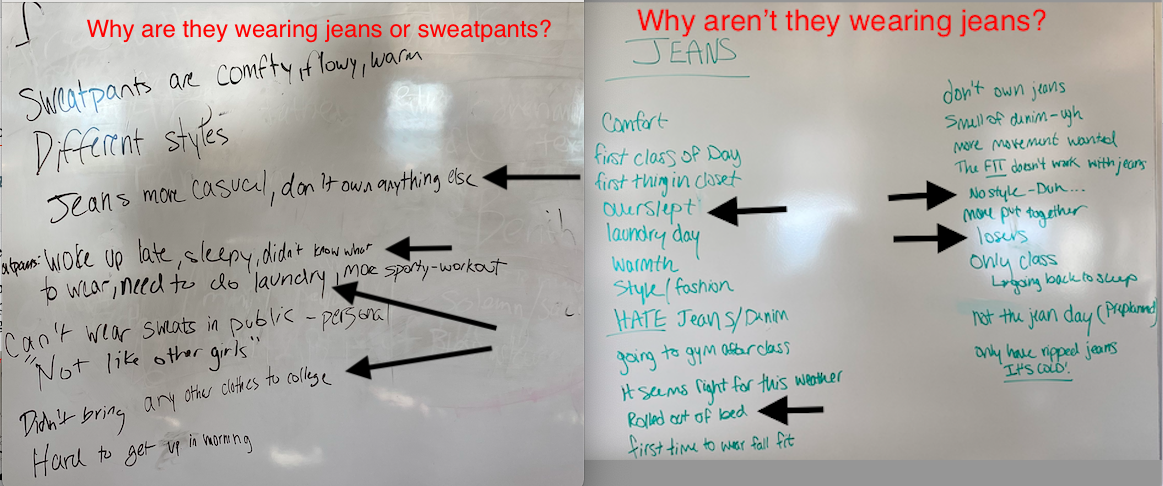
In just a few minutes, I created an in-group and an out-group.
Importance of Understanding Ingroup-outgroup Dynamics
In this case, Islam is the example, but it could be any religion, ethnicity or group. United States' history is punctuated with examples of groups that have been scapegoated and vilified. This is how Muslims have been treated in many cases in post-911 America. For many Americans, Muslims are an outgrip and so Americans who don't know any Muslims easily fall prey to stereotyping/overgeneralizing them, judging them, fearing them. But I have had so many Muslim students that I don't see them as an outgroup, nor do I see them with homogeneity, or a monolith. And that is what this video is showing. There are caring, loving, neighborly Muslims all around us and they a diverse group of people, but when they are an outgrip, it is easy to not see these realities. Here is a link to a page hoping to end stereotypes about Muslims.
In fact, in the wake of 9/11, many Muslims were stereotyped as terrorists and some were victims of vengeful hate crimes. But because of outgroup homogeneity, the first person murdered as a hateful vengeance for 9/11 was not even Muslim or Arab - he was Sikh. His name is Balbir Singh Sodhi Here is his story on NPR's Story Corps. And 15 years later, Sikhs are still being victimized. But Sodhi's brother has made it his mission to preach forgiveness.
Much of hate is based in fear, said Dr. A.J. Marsden, an assistant professor of psychology at Beacon College in Leesburg, Florida — "basically, fear of the unknown, fear of what might happen and fear of anything that's different than you or falls outside your definition of what's supposed to be normal."
"We establish ourselves as a tribe, and we say this is the group for which I have a love for, for which I identify with" Marsden cited Islamophobia as an example."There's a lot of hatred in the United States toward Muslims," she said. "One of the reasons is they don't understand the religion. ... There's a lot that they don't know, and that scares them, because there is a small part of Muslims who are violent, and that is what is driving the hate."
That concept is known as the "in-group/out-group theory" — the idea that people tend to define themselves in social groupings and are quick to degrade those who don't fit into those groups."
2017 Research about media coverage of Muslims affects outgroup Americans fears
"New research from Erin Kearns and colleagues at Georgia State University shows that the president is right — sort of. There is a systematic bias in the way terrorism is covered — just not in the way the president thinks.Connecting research, ingroups-outgroups, mindfulness and the fear of guns v. terrorism
Kearns says the "terrorism" label is often only applied to cases where the perpetrator is Muslim. And, those cases also receive significantly more news coverage.
"When the perpetrator is Muslim, you can expect that attack to receive about four and a half times more media coverage than if the perpetrator was not Muslim," Kearns says. Put another way, "a perpetrator who is not Muslim would have to kill on average about seven more people to receive the same amount of coverage as a perpetrator who's Muslim."
Perhaps these findings are not all that surprising to you. But there are disturbing implications for the way Americans perceive Muslims, and the way Muslims perceive themselves."
https://qz.com/898207/the-psychology-of-why-americans-are-more-scared-of-terrorism-than-guns-though-guns-are-3210-times-likelier-to-kill-them/
According to the New America Foundation, jihadists killed 94 people inside the United States between 2005 and 2015. During that same time period, 301,797 people in the US were shot dead, Politifact reports. But... Americans are more afraid of terrorism than they are of guns, despite the fact that guns are 3,210 times more likely to kill them.In this example, the media and most Americans see terrorists as an outgroup and because some terrorists claimed to act in the name of Islam, Americans stereotype the category of Muslims into terrorist. The fear, mistrust and stereotype result from most Americans seeing them as an outgroup.
Chapman University has conducted a Survey of American Fears for more than three years. It asks 1,500 adults what they fear the most. It organizes the fears into categories that include personal fears, conspiracy theories, terrorism, natural disasters, paranormal fears, and more recently, fear of Muslims.
In 2016, Americans’ number-one fear was “corruption of government officials”—the same top fear as in 2015. Terrorist attacks came second. In fact, of the top five fears, two are terror-related. And number five is not fear of guns but fear of government restrictions on guns. Fear of a loved one dying—whether by gun violence or anything else—came next.
... after the terror attacks of Sept. 11, 2001, people began flying less and driving more. The result, estimated Gerd Gigerenzer, a German risk specialist, was that 1,595 more Americans died in road accidents during the 12 months after 9/11 than would have otherwise. Michael Rothschild, then an emeritus professor at the University of Wisconsin, calculated some of the risks we face:
One in 6 million: Risk of dying in a plane hijacking, assuming you fly four times a month and hijackers destroy one plane every year. (Just to be clear, since 9/11, hijackers have not destroyed any flights in the US.)
One in 7,000: the risk of dying in a car accident in any given year
One in 600: the risk of dying from cancer in any given year
According to data compiled from the Centers for Disease Control, over 2005-2014, an average of 11,737 Americans a year were shot dead by another American (21 of them by toddlers), 737 were killed by falling out of bed, and nine were killed by Islamic jihadists—who in most cases were US citizens, not immigrants (Nearly twice as many Americans kill themselves with guns as kill each other).
Former marine Richard "Mac" McKinney was determined to bomb the local Islamic center in Muncie, Indiana. But the kindness he was shown there not only made him drop his plans, but eventually become a member of the community. The story is told in the new short film "Stranger at the Gate," directed by Josh Seftel.
This episode of On Being demonstrates how creating an ingroup can also create empathy.
"We'd heard Derek Black, the former white power heir apparent, interviewed before about his past. But never about the friendships, with other people in their twenties, that changed him. After his ideology was outed at college, one of the only orthodox Jews on campus invited Derek to Shabbat dinner. What happened over the next two years is like a roadmap for transforming some of the hardest territory of our time."

Now think about your own life. What are your in groups? What are the outgroups that you could become more aware of, more empathetic to?

Joel Charon's "Should We Generalize About People?" and Ingroups-Outgroups
6. How is Charon's article "Should We Generalize?" related to understanding outgroups? What is the answer to "should we generalize?"
7. What is the difference between a generalization and a stereotype?

Brett Eastburn
Brett Eastburn was born with no arms or legs. Here is an article in the Daily Herald about Eastburn visiting a school in Mt. Prospect. We might categorize him as disabled, but we should be careful about the assumptions and stereotypes that go along with that category. Here is a Ted Talk by Eastburn and here is his book, I'm Not Missing Anything.
Nick Vujicic
Another powerful differently-abled speaker is Nick Vujicic. He is a motivational speaker who also has no limbs. Here is a video of him on youtube
Here is the latest update from Wheelz on the BBC.
I love how these "disabled" people see their opportunity to teach others. Their lessons seem to be similar: The world doesn't owe you anything. You owe yourself hard work and dedication to become what you want. Find a way to help others/teach others. Don't stereotype and keep an open mind.
Lessons from differently-abled individuals:
- Accept yourself as a part of creation; your existence is the universe's confirmation to you that you matter.
- Develop your talents/desires. Whatever you want takes hard work. It takes failure, discomfort and effort.
- Find ways to serve others. Whenever you don't know what to do or when your life feels directionless or meaningless, find a way to serve others. We all have talents that can help others.
Finally, when you feel like you have been stereotyped, how do you react? What do you do? Anis Mojgani suggests that you shake the dust. Checkout his slam poem. Here is a link to his poem in writing.
Lesson from Mojgani: When you have been stereotyped, shake the dust. Move on and don't let the dust settle on you. Don't let it define you.
There is a poem I like that illustrates Charon's point. The poem called "The Cookie Thief" by Valerie Cox. We are all cookie thieves sometimes in how we erroneously use the categories that Charon talks about.
Lesson:
We have all been both the victim of stereotyping and the perpetrator of it. Try not to be the cookie thief.
Data, Statistics and Research; Joel Best's Damned Lies and Statistics

Like the video explains, research is rigorous and sometimes slow and tedious. It takes time and trials and analysis. Research doesn't lend itself to sweeping generalizations - it is usually more specific and targeted, nuanced. Examining Statistics in Sociology (and generally) requires critical thinking. By critical, I mean being detailed and inquisitive about the stats. For example, let's examine the following claim that we hear often (and many of us or our parents may even have said).


Cops say masked teens with a thirst for violence and joyrides are terrorizing the city. An examination of arrests reveals a narrative built on shoddy data and anecdotal evidence. From the article;
From the way CPD has presented the numbers it’s not at all clear how many of the 1,127 arrests were actually related to last year’s 1,417 carjacking cases. Deenihan didn’t explain that oftentimes CPD arrests multiple people related to a single carjacking incident, nor did he mention how many of those arrests were for incidents that happened in prior years. In a table breaking down arrestees’ age ranges in five-year increments, the 15-20 age group was indeed the largest in 2020. More than half of the people arrested, however, were actually over the age of 20.
"It’s bullshit. It’s just false. It’s wrong, the way it’s being talked about,” University of Chicago sociologist Robert Vargas told me months later. “From the beginning the city crafted this narrative as if it were young people seeking joyrides who were committing the carjackings, when anyone who’s taken a simple statistics course would know they’re basing their conclusion off a tiny fraction of data....”
While carjacking had spiked, last year saw 21,567 fewer robberies, burglaries, and thefts compared to 2019. This was part of a yearslong trend in the decline of these types of crimes. About 18,000 parked, unattended cars are stolen every year in Illinois, and that hadn’t become more common in 2020; CPD claims that these days cars are easier to steal because many people leave their key fobs in their vehicles. “Meanwhile this one uptick in this one subcategory of robbery had story after story and press conference after press conference,” she remarked about carjacking.

Violent crime is generally contrasted with property crime, with the latter defined as the taking of money or property without force (or the threat of force) against the victims. Note that in these definitions, robbery counts as violent crime whereas burglary does not. Comparing the the number of committed crimes in U.S. by category, property crime far outnumbers violent crime, while aggravated assault accounts for some two-thirds of all violent crime.


The violence was also extremely concentrated. Skogan said 50 percent of all the shootings in 2016 occurred in just a handful of neighborhoods, including Austin, Garfield Park, North and South Lawndale, Englewood, and West Pullman. The crime is even more concentrated in those communities, often occurring within just a few blocks. There is one four-by-four block area in Humboldt Park, Skogan said, that has been in the top 5 percent of shootings in the city every year for 27 years.

How safe is Chicago? The answer depends on where you're standing.The North Side is as safe as it's been in a generation, with a homicide rate that has declined steadily throughout this century, barely ticking up during the especially violent years of 2016 and 2020, then falling again in 2021, even as the city as a whole experienced its bloodiest year since the mid-1990s, according to Chicago Police Department data.
The homicide rate for the city’s four North Side police districts (the 18th, 19th, 20th and 24th) last year was 3.2 residents per 100,000, according to analysis of data from the University of Chicago Crime Lab—lower than Evanston’s, Champaign’s and Springfield’s, based on data from the Federal Bureau of Investigation. Overall, Chicago’s per-capita murder rate is higher than in New York City or Los Angeles, but is lower than in Midwestern cities such as Detroit, Milwaukee and St. Louis.


Why People Misperceive Crime Trends (Chicago Is Not the Murder Capital) from the NYT Upshot (2021)

No comments:
Post a Comment