Friday, February 7, 2025

Crisis at the US Border? Migrants, Immigrants, Asylum Seekers, and Refugees


Since Donald Trump launched his campaign for President, he has generated much discussion of people coming to the US.  His 2015 speech can be read here,  
When Mexico sends its people, they’re not sending their best...They’re sending people that have lots of problems, and they’re bringing those problems with us. They’re bringing drugs. They’re bringing crime. They’re rapists....

This discussion continues to manifest into familiar tropes such as:

"migrants coming to the US" 
"crisis at the border"
"stealing jobs" 
 "bringing drugs"
"causing violence"

How can we think critically about this?  What is meant by "migrants," "undocumented," or "illegal" immigrants?  What is the "crisis?"


Operationalizing Who is Coming to America
There are different types of people who are seeking to come to the U.S.

Migrant Workers - the US permits hundreds of thousands of seasonal workers to work temporarily (less than a year) in the country.
Asylum Seekers - people who are seeking asylum from oppression in another country. 
Immigrants - people who want to live in the U.S. so they file paperwork and wait for approval and then travel here. 
Refugees - people who are forced to flea due to violence or a threat of their basic needs.
Entry Without Inspection (EWI) or Undocumented - These are people who avoided any customs agents and entered the country without any inspection by border agents. 

Note that many people use the term "Illegal" or "Unauthorized" Immigrants to refer to EWI people.  However, Illegal is an amorphous term can be used to describe very different people who come to the US. Often it is used to describe people who do not have authorization to be in the US - even if that authorization is forthcoming. More about the difference at Migration Policy Institute.  Depending on their interpretation, the term "illegal" may refer to any of the following: 

    • Migrant workers who continue to work after their permission has expired no longer have authorization. 
    • Asylum seekers who (under the law) are awaiting their trial to determine if they are allowed to stay might be considered unauthorized because they have not yet been granted permission by a court.
    • Refugees may have fled the dire situation in their previous country without any paperwork, so their lack of documentation may be considered unauthorized even though they may be allowed to remain in the country while they get the appropriate authorization.  

All of these groups are tangentially related.  They are all legal ways that people come to the USA.  They use the same courts and the same Federal offices.  However, the "crisis" over the last several years has been mostly about asylum seekers. Worldwide there has been a growing instability (from climate change and social media and rise of autocracy) for more than a decade now that has resulted in people seeking asylum in the US. The US immigration courts have been underfunded and understaffed for decades so they have not been able to handle the influx of asylum seekers coming here. But US law guarantees these asylum seekers a trial and it permits them to wait in the US until their trial.  So, many of them are released into the US while they await their trial.  These people are sometimes referred to as "undocumented immigrants."

Migrant Workers, Asylum Seekers, Immigrants or Refugees are all people who did not enter the US without inspection (EWI). EWI is a label for people who gained entry to the US without being inspected by border control. 

Undocumented/Unauthorized Immigrants
As explained above, some of those people who show up at the border are considered "undocumented." This is the term that is most closely associated with "illegal" immigration.  However, even this term is ambiguous.  There are different reasons that some people will be undocumented.  Immigrants Rising provides an explanation of the different types of immigrants who are "undocumented":

DACA
Some of the undocumented people may have been here since they were children.  These people may not have any recollection of life elsewhere and no social ties to any other country.  Many of these people who arrived in the US as children have been allowed to stay under the DREAM Act from 2001 and continued under Obama administration's Deferred Action for Childhood Arrivals (DACA) program.  The National Immigration Law Center explains it here.
 
"Anchor Baby" Myth 
Other people may have been born within the US to parents who were undocumented. These children are US citizens by law. A long time misleading trope is that these children, who are technically US citizens, secure their parents a place in the US.  However, Georgetown Law School explains why this is a misleading trope.  Simply put, if the parents are undocumented, having a child who is an American does not protect them from deportation.

The unauthorized immigrant population in the United States grew to 11.0 million in 2022, according to new Pew Research Center estimates based on the 2022 American Community Survey, the most recent year available. The increase from 10.5 million in 2021 reversed a long-term downward trend from 2007 to 2019. This is the first sustained increase in the unauthorized immigrant population since the period from 2005 to 2007.

However, the number of unauthorized immigrants living in the U.S. in 2022 was still below the peak of 12.2 million in 2007.

George W  Bush Center has solutions for undocumented workers

The American Psychological Association has an explanation of undocumented immigrants and  the effects of that status on their psychology.

It should be noted, however, that:
  • The modern rise in undocumented immigrants can be traced to the 1965 Immigration law which prioritized immigrants with skills regardless of their country of origin.  Prior to that, countries were given quotas.  So, for example, Italy could send a certain number of immigrants which included skilled as well as unskilled workers. Without these skilled workers, many industries had trouble finding low-skilled, inexpensive workers.  They turned to workers who could find their way to jobs over the Southern border.  This resulted in large industries relying on these workers and the federal government looking the other way in order to satisfy the wealthy and powerful corporations.  Here is a chart from Visualizing Capitalism that shows the industries relying on this workers:
  • NONE of the immigrant groups mentioned above are responsible for a majority of illicit drugs coming across the border - especially Fentanyl.  From the Immigration Forum,
Evidence indicates that illicit fentanyl is primarily brought to the U.S. by American citizens and usually through legal ports of entry. The calculation is simple: illicit drug smuggling organization are likely to prefer U.S. citizens as smugglers because they are less likely to raise alarms or undergo additional vetting when re-entering the U.S. through a legal port.
The U.S. Sentencing Commission recently released an annual report on incidents related to fentanyl trafficking. In fiscal year (FY) 2022, 19,851 drug trafficking offenses were reported to the Commission. Of these, 2,362 (about 12 percent) were fentanyl-trafficking cases. This represents a steady increase since FY 2018, when there were only 422 reported offenders – an increase of about 460 percent in four years. The report shows that most fentanyl trafficking offenders in FY 2022 were U.S. citizens (88 percent). The vast majority were men (82 percent), with an average age of 35 years. A large proportion (40 percent) had little or no prior criminal history.
Data from previous years also indicates the significant role U.S. citizens play in fentanyl smuggling. In 2021, 86 percent of fentanyl trafficking convictions were for U.S. citizens. The Cato Institute also notes how just 0.02 percent of people (279 out of 1.8 million migrants) encountered by the Border Patrol for crossing unlawfully possessed fentanyl. While CBP and other border officials must deal with challenges at the border related to processing asylum seekers, the trafficking of fentanyl itself is largely connected to U.S. citizens.  

"Illegal" Immigrants
When Americans hear that the Trump administration is arresting "criminals," they often are thinking of drug dealers, violent offenders, and gang members. However, numerous reports and data show otherwise:
There are different reasons why someone may be considered an "illegal" immigrant. First, if someone attempts to enter the US in a way that they do not have permission to do so, Immigration and Control can detain them as a "criminal noncitizen arrests." This might include someone entering the US without a visa (if their nationality requires one) or it could be a person who entered the US as a tourist, but they work here. This category makes up about 50% of people who are considered "illegal." (The dark green in the chart below.) People who fall into that category are only violating the law based on their citizenship status - they are otherwise just like any other law abiding resident of the country. Some cities have acknowledged that these people are like other residents of their municipality; they work, have families, pay taxes and live a law-abiding life - so these cities have said that they will not prosecute them for their citizenship status. These cities are called sanctuary cities.

From USAFacts,

The other reason that someone might be considered "illegal" is that they have a conviction on their record (in either the US or their home country) that means they are not allowed to enter the US. (The light green in the chart above.)


The Migration Policy Institute explains who can be deported in this graphic:


Migrants

Migrant Clinician defines "migrant" and explains healthcare challenges for them.

How has the economy managed to prosper, adding hundreds of thousands of jobs, month after month, at a time when the Federal Reserve has aggressively raised interest rates to fight inflation — normally a recipe for a recession?

Increasingly, the answer appears to be immigrants — whether living in the United States legally or not. The influx of foreign-born adults vastly raised the supply of available workers after a U.S. labor shortage had left many companies unable to fill jobs.

More workers filling more jobs and spending more money has helped drive economic growth and create still-more job openings.

From Daniel Costa of the Economic Policy Institute, America Is ‘Terrorizing’ These Workers

Migrant workers in America are in limbo. It’s time to change things.For decades, our broken immigration system has prioritized temporary workers over immigrants who have equal rights and can eventually become citizens and participate fully in American political life. 

 From the Council on Foreign Relations, U.S. Temporary Foreign Worker Visa Programs,

President Donald Trump promised to reform temporary foreign worker programs, also known as guest worker programs, in line with his “Buy American and Hire American” agenda; although his proposals to overhaul the country’s immigration system stalled in Congress, his administration managed to halt most foreign worker visa programs during the COVID-19 pandemic. President Joe Biden has sought to reverse his predecessor’s approach by expanding the legal opportunities for temporary migration, but reform efforts have also faced resistance from some policymakers.

Asylum Seekers
Perhaps what is most important to now is that international law establishes who can seek asylum: People fleeing persecution because of their race, religion, nationality, political opinion or social group.  If a person comes to the US and claims they are a member of a persecuted group and they have a credible fear of going back to their homeland, they can request a hearing for asylum.  US law states that these people are allowed to stay in the US while they await their hearing.  Recently, the number of people requesting hearings for credible threats has sky rocketed.  And this is all within an immigration system that was already overburdened with cases.  So, while these people await hearings, some governors are putting them on buses and sending them to other cities around the country.

This PBS video helps explain asylum seekers and the process for seeking asylum in the US:


Some things to know about asylum seekers:

Treacherous Trek:  The trek to asylum is no small thing.  Most of the asylum seekers make their way to Colombia where they hike on a treacherous passage known as the Darien Gap, a route that goes from Colombia through wild jungles of Panama with dangerous conditions, gangs, and deadly animals.  Parts of the route have gotten more organized over the last several years, but it still remains a daunting task.  Then they make their way, often paying bribes to gangs or guides who get them to Mexico.


TX governor Abbot is not helping.  The Texas governor is nefariously sending migrants to cities without communicating with such cities, largely as a political stunt.


Problems with how the US deals with undocumented people have been around since the 1970s as detailed in this Time Magazine article.

Council on Foreign Relations details many aspects of the crisis here including increasing asylum seekers from Haiti and Central America, and an immigration backlog.

Asylum seekers fleeing dire situations overseas are in search of a better life in the USA.

Watch this video about the role that Viator house plays in helping teen refugees:


Asylum seekers are increasingly flying to South America and making their way by land to the USA including through very dangerous Darien Pass including the jungles of Panama. Outside magazine features the dangerous journey here:


And PBS highlights the dangerous journey here in Part 1/2:
Whether fleeing war, persecution, poverty or the effects of climate change, migrants and refugees worldwide routinely find themselves in great danger. Perhaps the most hazardous migrant trail of all is the Darien Gap, a wild, lawless stretch straddling Colombia and Panama. Before the pandemic, special correspondent Nadja Drost and videographer Bruno Federico reported from this perilous path.


And part 2/2 from PBS is about how the U.S. immigration policy affects the asylum seekers.

This 2025 episode of 60 minutes detailed the story of an asylum speaker under the Trump administration.  A Venezuelan man with no criminal record felt threatened because of his sexuality (he is gay) and his politics. He walked the thousand miles through the treacherous Darien Gap and across numerous countries to reach a LEGAL immigration entry point in the US.  Fearing for his life in Venezuela, he asked for permission to remain in the US. Under US law, he is entitled to a hearing to determine his eligibility to remain in the US as an Asylum seeker. While waiting for his case in the US, he had no criminal offenses. The Trump administration arrested the man and without a trial sent him to a prison in El Salvador.  


Immigrants


CATO analysis of Obama legacy on immigration.

top recent sociology on immigration
In light of the Obama administration's 2014 DACA program, Contexts put together the most cited articles on immigration from the five years (2009-2014) in three leading sociology journals: American Sociological Review, American Journal of Sociology, and Social Forces.

  • Want to know whether immigrants are more or less likely to work in a particular industry than native-born Americans? Pew’s data tool uses American Community Survey data to break it down by state.
  • If you’re interested in how the age and sex distributions of US immigrants compare to those of the native born population, The Migration Policy Institute used IPUMS data to put together interactive population pyramids comparing the populations in the US over time.
  • The Department of Homeland Security maps out international students by state, showing there were over 2,799 international students in Maine as of November. They also offer downloadable tables of characteristics like age, marital status, country of origin and admission category for greencard holders, nationally and by state.
  • The Urban Institute has a data tool that pulls information on children of immigrants from the American Community Survey, so if you wanted to know what percentage of children of immigrants in the US had parents with a Bachelors’ degree (33%), it’s a few clicks away.
  • Population Reference Bureau’s data finder generates statistics (and charts and maps) on demand.  Want to know the percentage foreign-born in each state’s population? You’re a few clicks away from a map.
Immigrants and refugees are often criminalized and this article highlights three realities:  
  1. Companies and government bodies benefit from the criminalization of immigrants.  
  2. Global capitalism and institutional racism produce the “facts” that are used to justify immigration control.
  3. In reality, immigrants and their communities face extreme threats.

Is unauthorized immigration an economic drain on american communities? research says no.
Sociologist Helen Marrow and race and education sociologist Will Tyson reached out to other North Carolina sociologists with expertise in immigration: Susan C. Pearce of East Carolina University and Martha Crowley and Kim Ebert of North Carolina State University.  Marrow thought of her own students at Tufts University outside Boston, so often surprised to learn what sound, peer-reviewed research says about these matters. “We never hear this,” one student said of such research in 2016. “All we hear are the negative messages [about immigrants] in the media. We hear it so much we even believe it, too.” 
Together, our team has aimed to do three things: 1) assess the soundness of the data Miller presents, taking her up on her suggestion to use her sources to verify her claims; 2) provide more accurate information regarding the economic impacts of immigrants and immigration, using peer-reviewed research; and 3) offer an explanation for how and why flawed and biased anti-immigrant messages are so often reported in the media. The literature on this topic is vast, so we highlight just a few key points that readers can use to learn how to spot and critique biased and unfounded messages about immigrants and immigration in their own communities.
1) Purely Negative Media Accounts of the Economic Costs of Unauthorized Immigration Often Rely on Questionable Sources.
2) Unauthorized Immigrants Have Little or No Negative Effect on the Wages and Employment of U.S.-born Citizens, and Immigrant Workers Have Positive Effects on American Consumers.
3) Unauthorized Immigrants Do Not Have Large Negative Fiscal Impacts on Taxes and Public Spending When Long-Term Effects and Contributions to Federal Coffers Are Taken into Account.
4) What’s Really Going On? Research Points to Economic, Cultural, and Racial Anxiety.

looking “illegal”

From sociologist, San Juanita García’s 2019 article in Sociology of Race and Ethnicity.  
The review of Garcia's work in Contexts explains, 
“When Mexico sends its people, they’re not sending their best. They’re sending people that have lots of problems, and they’re bringing those problems with us. They’re bringing drugs. They’re bringing crime. They’re rapists.” Since this statement in June 2015, Donald Trump’s rhetoric has only intensified the Latino Threat, by which anti-immigrant attitudes toward Latinx and Hispanic individuals in the U.S. are intensified. It has also provided the underpinnings of 
García wanted to understand how Mexican-origin women experience racialization in an anti-immigrant climate and what that means for their sense of belonging or exclusion. She interviewed 60 Mexican-origin women residing in Houston, Texas.García ends with a caution: since the 2016 presidential election, scholars have documented a rise in harassment and intimidation of those perceived to be “illegal,” and it shows no signs of abating. She calls on academics to delve more deeply into the ways racialization and “illegality” unfold in the lives of immigrants and other vulnerable populations.

Refugees

Admitted based on the 1980 Refugee ACT which aligns with international law.  Many people consider accepting refugees as a humane and compassionate act.  And, I think you could make the case that it is in our nature to empathize with our fellow humans who are experiencing war, famine and violence.  However, accepting refugees is not only a moral choice, it is also a very practical one.  

Refugees have added immensely to American culture and success.  For example, from rescue.org, here is a list of famous refugees including:  Albert Einstein, Madeleine Albright, Ellie Wiesel, Sergey Brin, among others. And from the UN here is a list of prominent refugees who have made a difference.  And, here is Time Magazine's list of important refugees.

Second, not only do refugees enhance American ingenuity and success, but they also provide America a platform to speak out for humanitarianism, democracy and peace.   Refugees are generally fleeing from untenable situations of war, violence, famine, and persecution.  Many refugees are at risk because of helping the U.S. with conflicts overseas.  For instance, Iraqi and Afghani citizens are threatened with violence for aiding the U.S. with intelligence and other military operations.  

World Relief is an International Aid organization HQ'd in Chicago suburbs that helps resettle refugees.
 
This article from the EU explains some of the difficulties refugees face in traveling to other countries.

Immigrants choose to leave but refugees are forced.
The road to refugee:
Flee homeland, leave everything behind, find temporary shelter (avg stay is 5 years) sometimes living in the forest for an extended time
Interview with UNHCR; often involves reliving the events
Wait for acceptance and nation to accept you
The US resettles 50-60% of worldwide refugees
If accepted, go wherever you are sent and be prepared to pay back airfare costs!

26 million refugees worldwide.
50-80,000 refugees accepted to the US each year

$900 given to each refugee to make it through the first 3 months!
IL is 7th largest recipient of refugees by state in the US

UNHCR – US Dept state – IOM Travel logistics – Resettlement Services

World Relief Services:
  • Initial resettlement
  • Employment Services
  • Education Services/ESL
  • Refugee Counseling Services
  • Youth Services
  • Volunteer and Church Relations
  • Citizenship and Immigration Legal Service
Challenges:
  • Educational factors: ESL and lagging academics
  • Family and Cultural Dynamics:
    • Parent-child role reversal
    • Lack of parental involvement in students’ lives
    • Lack of parental involvement in school
    • Different parenting styles and discipline
  • Past and Current Trauma/stress
  • Identity crisis
IL refugees:
  • Bhutanese
    • Ethnic Lhotsampa
    • 108,000 people displaced
    • Imprisoned, abused, denial of human rights
  • Iraqi
    • Very different from Bhutanese
    • Recent refugees, short term
    • Kids have seen and experienced more turmoil than Bhutanese

Viator House
Also in the Chicago suburbs is the Viator House of Hospitality
Home for male young adults seeking asylum


Recent Sociological Trends and Refugees

Despite the benefits cited above, the U.S. runs the risk of losing its moral authority regarding refugees as well as its credibility with those who aid U.S. operations overseas because of recent trends regarding refugees.

First, there has been a shift in political rhetoric that uses refugees as an outgroup.  Remember we learned that it is easier to mistrust, judge and demonize outgroups.  And this PEW research shows that support for refugee settlement has been stronger when the group was European/White. 

And the graphs below show how easy it is to highlight refugees as an outgroup because the wars in Afghanistan and Iraq shifted the need for refugee status to Asians and Muslims.


Here are stats from the UN Refugee Agency showing the drastic rise in refugees worldwide over the last decade created by instability from climate change and political upheaval:


World Vision also details the sources of refugees and how to help them.  
Statista shows the numbers in the graph below:


The Trump administration has capitalized on refugees as an outgroup by promoting anti-immigration and anti-refugee rhetoric.  The National Immigration Law Center has a list of Trump's tweets about refugees here.  For example:
In a response to this dangerous rhetoric, in 2016 The American Sociological Association published this statement, including:
In recent years (2016), vitriolic characterizations of immigrants and draconian plans for their exclusion have been floated by political candidates to a surprisingly receptive public. While the U.S. extended refugee status to 3 million persons since 1975, only about 28 percent of the American public currently endorses the continued admission of Syrian refugees. 
...the advent of cable news, the Internet, and social media have created additional venues for anti-immigrant sentiments. Their mobilization has shaped the fate of individual candidates, legislative agendas, organizations and social movements on the local, state, and national level....
The degree of anti-immigrant sentiment currently displayed in U.S. society is sizeable and strongly felt. However, despite aphorisms about America’s status as “a nation of immigrants,” evidence of anti-immigrant sentiment is clear and longstanding among wide swaths of the public. The reasons for its recent acceptability might be partly attributable to opportunities to express opposition to immigration in a manner that would have been politically unacceptable prior to the 1990s. In this way, analyses presented by sociologists and other scholars of migration can help us account for changes in popular views of immigration.

Secondly, not only has the rhetoric changed, but the actual policy has as well.  By law, the POTUS must notify Congress by the end of September what the refugee limit for the next year will be.  During the first year of his presidency,  Trump attempted to ban refugees and since then, the U.S. has reached its lowest level of refugees ever!  In 2017, the U.S. saw a historically low rate of refugees.

Pew documents the recent drop in refugees here.  In fact, 2017 was the first time in modern history that the U.S. has resettled fewer refugees than the rest of the world.  And this 2019 NY Times article details how President Trump slashed the number of refugees in the U.S. to even further record lows.

And, just a couple of weeks ago (September 2020) the current administration requested that the ceiling on refugees be set even lower than the record lows of 2018!  The Associated Press reports that here.  And the NY Times details the decision in this article,  Trump Virtually Cuts Off Refugees as He Unleashes a Tirade on Immigrants 


More research on refugees and immigrants from the sociology journal Contexts:

As refugees flee Central America, they met with hostility reminding the public that American identity is assumed to be White, Anglo-Saxon, and Christian. Anyone that doesn’t fit this profile is othered and scrutinized.  Also provides a review of exclusionary U.S. immigration policies, some of which go back to the 1960s but created the crisis in immigration today.

Sikh refugees survived a massacre in New Dehli in 1984 but the memory of the event has changed shape as it passes from one generation to the next.


U.S. Immigrant Population by State and County 
Interested in how many immigrants live in your state, their countries and regions of origin, and their top settlement destinations by county? This map displays the state-level distribution of immigrants in the United States by country and region of origin, and also provides a county-level view of the immigrant population.
U.S. Immigrant Population by Metropolitan Area 
Use this dynamic map to display the largest concentrations by metropolitan areas for immigrants overall, as well as by region or country of origin. The colors represent the density of immigrants in the total population, and the larger the bubble, the larger the concentration of immigrants.
Unauthorized Immigrant Populations by Country and Region, Top State and County Destinations
Learn about top state and county destinations for unauthorized immigrants in the United States based on their country or region of origin, as well as those who have or are potentially eligible for the Deferred Action for Childhood Arrivals (DACA) program, in this interactive map.
Deferred Action for Childhood Arrivals (DACA) Data Tools
Use these data tools to learn about populations who have DACA status or meet eligibility requirements nationally and by state and by top countries of origin.


Francis said he prayed that America would live up to its ideals of being a “land of opportunity and welcome for all....It is my hope that under your leadership the American people will prosper and always strive to build a more just society, where there is no room for hatred, discrimination or exclusion,” he wrote in the telegram. If true, this will be a disgrace, because it makes the poor wretches who have nothing pay the bill” for the problem, Francis said. “This won’t do! This is not the way to solve things. That’s not how things are resolved.” Many U.S. bishops have firmly opposed Trump’s deportation plan, with the incoming archbishop of Washington D.C., Cardinal Robert McElroy, saying such policies were “incompatible with Catholic doctrine.” It was a reference to the Biblical call to “welcome the stranger.”

Another cardinal close to Francis, Chicago Cardinal Blase Cupich, said the reports of mass deportations targeting the Chicago area“are not only profoundly disturbing but also wound us deeply.”

In a statement delivered from the Basilica of Our Lady of Guadalupe in Mexico City on Sunday, Cupich said governments have the responsibility to protect borders and communities.
And this Jesuit priest writes about the effects of the sweeping changes of the second Trump administration (1/20/2025):


From the United Nations


1.09 Categories, Generalizations and Stereotypes cont'd

 Categories and Stereotypes Cont'd


3. Why is it important to be sociologically mindful of our ingroups and outgroups?


4.  Examine the research article that you found for this unit.  
Was the research focused on an ingroup or outgroup for you?   

5.  How might your research shed light on this group to avoid viewing the group with outgroup homogeneity?

6.  Now think about your own life.  What are your in groups?  What are the outgroups that you could become more aware of, more empathetic to?


Examples of stereotypes and lessons we can learn from them:
 

Examples of stereotypes about differently-abled individuals 

Brett Eastburn
Brett Eastburn was born with no arms or legs.  Here is an article in the Daily Herald about Eastburn visiting a school in Mt. Prospect.  We might categorize him as disabled, but we should be careful about the assumptions and stereotypes that go along with that category.  Here is a Ted Talk by Eastburn and here is his book, I'm Not Missing Anything


Nick Vujicic
Another powerful differently-abled speaker is Nick Vujicic. He is a motivational speaker who also has no limbs.   Here is a video of him on youtube


Aaron Fotheringham
This is a video about Aaron Fotheringham, an "extreme sitter." Aaron has been in a wheelchair his whole life, but he sees it as an opportunity. Again, we should be careful of our stereotypes. Aaron is way more rad than I will ever be, but he is in a wheelchair and I am not.  If you search youtube, you can see Aaron doing a double backflip! But there are also lots of videoes of him crashing over and over again and again. It takes hard work and lots of effort to become good at what you do.  

Hard work was a theme in all of the above videoes.  And if you read the rest of Outliers, Gladwell makes the case that the most successful people spend ten thousand hours developing their skills.  The other theme that comes out in all of these videoes from Brett Eastburn to Aaron Fotheringham is that in order to find meaning in your life you must find a way to serve others.  Find a way to help other people.  You have talents.  Develop them and find a way to use them to help others.  That is your purpose.  And here is Aaron "wheels" Fotheringham at the 2016 Paralympics:


Here is the latest update from Wheelz on the BBC.
 
Here is a video about a different type of street performer that also challenges your assumptions about the category "disabled".


I love how these "disabled" people see their opportunity to teach others.  Their lessons seem to be similar:  The world doesn't owe you anything.  You owe yourself hard work and dedication to become what you want.  Find a way to help others/teach others.  Don't stereotype and keep an open mind.

Lessons from differently-abled individuals:
  • Accept yourself as a part of creation; your existence is the universe's confirmation to you that you matter.
  • Develop your talents/desires.  Whatever you want takes hard work. It takes failure, discomfort and effort.
  • Find ways to serve others.  Whenever you don't know what to do or when your life feels directionless or meaningless, find a way to serve others.  We all have talents that can help others.


Dealing with stereotypes
Finally, when you feel like you have been stereotyped, how do you react? What do you do? Anis Mojgani suggests that you shake the dust. Checkout his slam poemHere is a link to his poem in writing.


Lesson from Mojgani: When you have been stereotyped, shake the dust.  Move on and don't let the dust settle on you.  Don't let it define you.


The Cookie Thief, a poetic example of judging
There is a poem I like that illustrates Charon's point. The poem called "The Cookie Thief" by Valerie Cox. We are all cookie thieves sometimes in how we erroneously use the categories that Charon talks about. 

Lesson
We have all been both the victim of stereotyping and the perpetrator of it.  Try not to be the cookie thief.


EXTRA:
This American Life, radio episode about stereotypes 
Another great source about stereotypes is episode 362 from This American Life. Click here to listen to the episode where 5 people tell stories about stereotyping. Listen to the prologue about people with disabilities, and Act One about NY cops stereotyping people coming from Brooklyn.


In Conclusion

What is difference between in-groups and outgroups?
Why should we be mindful of these groups?
What is the difference between a generalization and a stereotype?


Wednesday, February 5, 2025

2.03 Language, Culture and Ethnicity in the US

As we saw during our last lesson, culture is made up of different components that shape how we think and act and what we assume is normal.  Another aspect of culture is language.

Symbolic culture is shared meaning that involves communication such as gestures and language.  

Gestures
What are examples of the importance of gestures?

Gestures are important to understanding and communicating within a culture.  Understanding a culture's gestures can also help us avoid ethnocentrism and culture shock.  Here is a guide for international business travelers to help them understand the impact gestures can have on their interaction with other cultures.  Here is a link to a list of some single-hand gestures from around the world.

Gestures are also an example that culture is a result of shared meaning among people.  And among groups of people, meaning can change over time.  Here is a post about the Bellamy Salute, a gesture that has changed its cultural meaning over time.  Another example of the changing meaning of symbols is the ok gesture which has become associated with white supremacy/white power and it is now listed as a hate symbol by the ADL.  See this link for a detail of that evolution.
Language itself is a cultural universal and part of human nature.  But the different meanings of language shared within each culture is an example of nurture.  People learn different meanings from their language.

Answer a few Questions about language without reading ahead:


1.  One of the shapes below is called a "Takete" and the other is called a "Malunga."  Take a guess which one is which:

            Shape A                    Shape B


2. Which one of the color circles below does not belong with the other two?


3. Which word does not belong or is the most different for each set below:

Set 1. Auto, turtle, basket, bird

Set 2. Laundry, beer, clothing

Set 3. A chair, a spear, a couch 


4. WHAT ARE THREE WORDS TO DESCRIBE THIS BRIDGE:


5. If you speak a language other than English, what is a word that you really like in that language?


WHAT IS THE IMPORTANCE OF LANGUAGE?


Language is important because it affects how we think. When we think about something, we are using language inside of our heads so if we use certain words or do not have certain words, it may affect how think about things especially how we categorize something.   We even think based on how words sound.  

For example, takete and malunga.  Takete sounds harsh and therefore angular.  Malunga sounds softer and rounded.  But these are just made up words.  
Shape A                    Shape B


What is the Saphir-Whorf hypothesis?


The importance of language was first highlighted by researchers, Saphir and Whorf.  Their hypothesis and conclusion was that language shapes how people think, especially when categorizing and naming.  For example, in the color samples above, Americans typically group the chips by blue and green, but Tarahumara people do not have a word for blue and green, instead they have words that mean the color of water and the color of night.  Because each group of people have different words with different meanings, it shapes how they think.

Another example of language's effects on our thinking is a lesson from Carol Mukhopadhyay on classifying in other cultures.  For each of the following sets, choose the item that does not belong:

Set 1. Auto, turtle, basket, bird
Students generally select auto or basket using the culturally familiar categorizing device of machines vs. non-machines or and movement vs. non-movement. At least some non-western cultural groups, however, would see birds as most different because their culture emphasizes shape and birds are relatively angular rather than rounded in shape. Our culture tends to emphasize use or functionality. Thus correctness would be culture-dependent.

Set 2. Laundry, beer, clothing
Students generally, with great assurance, select beer as most different. Functionality places clothing and washing machines together. Yet, at least one culture views clothing as different because laundry and beer are both “foamy”. Visual appearance is most salient. US slang for beer (“suds”) also recognizes the attribute of foaminess.

Set 3. A chair, a spear, a couch 
Students again select the “wrong” answer—at least from the perspective of traditional West African cultures. US Americans tend to emphasize use, thus placing couch and chair together as types of sitting devices (i.e. “furniture”). Ashanti apparently would see the “couch” as the most different because both a chair and a spear can symbolize authority.

Evidence of different languages with genderized nouns shaping how people think about those things:


Lera Boroditsky, professor of cognitive science and cultural psychology has published research that concludes language affects how we think.  Her evidence is in the genderization of nouns in different cultures.  Here she is explaining her research at Ted.  Here is an explanation from NPR about Boroditsky's research and how language shapes our description of bridges.  This Psychology Today article explains more about the importance of genderizing nouns in language.  This NPR story highlights how language affects our thinking, especially for bilingual speakers.  


University of Illinois Chicago's Language Lab provides some words that students most enjoy.  Here are three from Italian:

More evidence for the effect of language on thinking:
  • The NY Times ran a story about how the idea of language affecting our thoughts. See that article here
  • The ASA's Society Pages shares research by sociologist Matt Wray highlighted on NPR's Code Switch.  Why would using the term "white trash" support white supremacy?
  • This New Yorker article explains the research of professor Adam Alter on the hidden power of words and naming.
  • Also, here is a study explaining that without language, numbers do not make sense.
  • This episode of On Being from NPR is about Rabbi Heschel who insightfully explained "words create worlds."  Here is a link to a medium article about Heschel and words.  And this link to a passage about the importance of words from Heschel to William Blake. 
  • David Treuer is an Ojibway translator who explains the power and importance of language on this episode of On Being.
  • The episode Lost in Translation from NPR's Hidden Brain is a social science podcast from NPR and this episode explores how language shapes our thoughts.
  • Also, see this post about politics and how the use of English frames every debate especially the debate over gun violence.


Cultural Diversity and Language in the US today


Where cultures in the US come from:

There are different types of people who are seeking to come to the U.S.


Migrant Workers - the US permits hundreds of thousands of seasonal workers to work temporarily (less than a year) in the country.
Asylum Seekers - people who are seeking asylum from oppression in another country. 
Immigrants - people who want to live in the U.S. so they file paperwork and wait for approval and then travel here. 
Refugees - people who are forced to flea due to violence or a threat of their basic needs. 

This post has a detailed and critical analysis of  immigration to the US.


6. What are the different ways that a person from another culture might come to the USA?


General Immigration to the US:


As detailed by the Pew (2015), the number of foreign-born people living in the US reached its peak at 14.8% in 1890.  Then, it slowly declined to a historic low of 4.7% before the 1965 Immigration Act.  It wasn’t until the 1965 Act took effect that immigration began to increase until this year, 2023 when, for the first time in the history of the US, there are more than 15% of the population who are foreign-born. 


The PEW (2020) provides a snapshot of what immigration looks like in the US.  Mexico, China and India make up the vast majority of new immigrants to the US.  And, the Kaiser Family Foundation published a 2023 study about immigrants here.


Research the cultures/ethnicities in a locale.  


If you are from outside of Chicago:


The relative number of foreign-born people

Statista shows the US states with the highest percentage of foreign-born people living there:


What languages do we speak in the US from the Census:


The Migration Policy Institute provides details about who and how many immigrants are settling in different locales of the United States:


The Visual Capitalist which examines the most spoken languages besides English and Spanish in each state in the United States:


If You are From Chicago:

This graphic from Storymaps shows the most prominent languages in Chicago:


Chicago Health Atlas shows the levels of  neighborhoods in Chicago that report not speaking English "very well".

7.  What are the largest immigrant groups/non-English speakers either where you are from - either in the US or in your neighborhood of Chicago?

1.08 Ingroups and Outgroups


While waiting, please review Joel Charon's "Should We Generalize About People?"

Action Item for next class: Joel Best, "The Truth about Damned Lies and Statistics.


Please sit in your designated areas.


GYM SHOES or                                                                                    NO Gym Shoes

SNEAKERS                                                                                            NO Sneakers

<-------                                                                                                                     ------->


In and out is not just for burgers, it is also for groups! Sociologists use the terms ingroup and outgroup to refer to groups that you are either a member of (ingroup) or not a member of (outgroup).


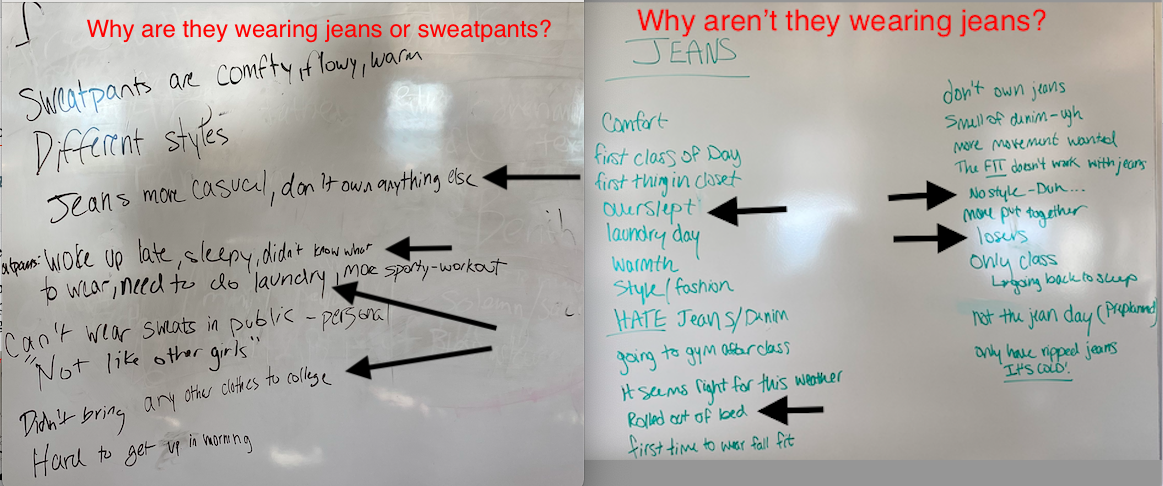
To illustrate this, today I separate the class into two different groups.   To put it another way, I create an ingroup and an outgroup for each student.  Each group made a list of reasons why the other group was in that outgroup. Every time I do this lesson, the reasons break down into judgments against the other group.

For example, in class I split students into 2 groups of students wearing spirit wear and those who were not. I asked each group to list as many answers as they could about the other group:


In just a few minutes, I created an in-group and an out-group.  

Ingroups are groups that an individual is in. You have membership in it, and because of that, you feel aligned to the group and you have ownership in it and you are more likely to trust it.  It is easier for individuals to recognize the diversity within their ingroups.

Out-groups, by contrast, are the groups that one is not a part of.  People tend to fear outgroups and judge them more than their own ingroups.  This can result in people unnecessarily fearing outgroups and scapegoating them.  They also tend to see outgroups as being less diverse and having less individuality/differences than those of an ingroup.  The tendency to view all members of an outgroup as similar is known as outgroup homogeneity.  Often, outgroups are based on a master status - a sociological term for a person's most salient group membership, or a group that defines the person to a society.

When I do this lesson, some years I divide students by who is wearing jeans, or who is wearing hoodies or who is wearing gym shoes.  Regardless of how arbitrary the groups are, a similar result happens:  students generalize about the other group and pass judgments.  This is a small example of what happens with ingroups and outgroups - imagine how much we are affected by the ingroups and outgroups that we experience from the time we are young.   


1.  What are some ingroups that you are a part of in your life?


Examples of how people can have fears and judgmental views of outgroups:


RACE
Jane Elliot's Brown Eyes/Blue Eyes illustrates racial outgroup attitudes
Jane Elliot, a teacher in the 1960s conducted an experiment in her third grade classroom to show the power of ingroups and outgroups.  
Here is a clip of her 1960s experiment:


And there is an updated version of this. Jane Elliot returns to do the experiment with college kids. Here is a 5 min clip.  And here is the whole video.

Here is Jane Elliot on Jimmy Fallon in 2021 talking about her experiment.


RELIGION:
Below is a link to a video called I am an American that shows the dangerous stereotypes that outgroup homogeneity led to in the wake of 9/11.  All of the audio is from real radio programs and it is juxtaposed on top of video of real Americans.

In this case, Islam is the example, but it could be any religion, ethnicity or group. United States' history is punctuated with examples of groups that have been scapegoated and vilified. This is how Muslims have been treated in many cases in post-911 America. For many Americans, Muslims are an outgrip and so Americans who don't know any Muslims easily fall prey to stereotyping/overgeneralizing them, judging them, fearing them.  But I have had so many Muslim students that I don't see them as an outgroup, nor do I see them with homogeneity, or a monolith.  And that is what this video is showing. There are caring, loving, neighborly Muslims all around us and they a diverse group of people, but when they are an outgrip, it is easy to not see these realities.  Here is a link to a page hoping to end stereotypes about Muslims.

In fact, in the wake of 9/11, many Muslims were stereotyped as terrorists and some were victims of vengeful hate crimes.  But because of outgroup homogeneity, the first person murdered as a hateful vengeance for 9/11 was not even Muslim or Arab - he was Sikh.  His name is Balbir Singh Sodhi   Here is his story on NPR's Story Corps.   And 15 years later, Sikhs are still being victimized.  But Sodhi's brother has made it his mission to preach forgiveness.


2017 Americans are afraid of Muslims especially after some people are scapegoating them:
http://www.nbcnews.com/news/us-news/psychology-hate-groups-what-drives-someone-join-one-n792941
Much of hate is based in fear, said Dr. A.J. Marsden, an assistant professor of psychology at Beacon College in Leesburg, Florida — "basically, fear of the unknown, fear of what might happen and fear of anything that's different than you or falls outside your definition of what's supposed to be normal."
"We establish ourselves as a tribe, and we say this is the group for which I have a love for, for which I identify with" Marsden cited Islamophobia as an example."There's a lot of hatred in the United States toward Muslims," she said. "One of the reasons is they don't understand the religion. ... There's a lot that they don't know, and that scares them, because there is a small part of Muslims who are violent, and that is what is driving the hate."
That concept is known as the "in-group/out-group theory" — the idea that people tend to define themselves in social groupings and are quick to degrade those who don't fit into those groups."

2017 Research about media coverage of Muslims affects outgroup Americans fears
http://www.wbur.org/npr/532963059/when-is-it-terrorism-how-the-media-covers-attacks-by-muslim-perpetrators
"New research from Erin Kearns and colleagues at Georgia State University shows that the president is right — sort of. There is a systematic bias in the way terrorism is covered — just not in the way the president thinks.
Kearns says the "terrorism" label is often only applied to cases where the perpetrator is Muslim. And, those cases also receive significantly more news coverage.
"When the perpetrator is Muslim, you can expect that attack to receive about four and a half times more media coverage than if the perpetrator was not Muslim," Kearns says. Put another way, "a perpetrator who is not Muslim would have to kill on average about seven more people to receive the same amount of coverage as a perpetrator who's Muslim."
Perhaps these findings are not all that surprising to you. But there are disturbing implications for the way Americans perceive Muslims, and the way Muslims perceive themselves."
Connecting research, ingroups-outgroups, mindfulness and the fear of guns v. terrorism
https://qz.com/898207/the-psychology-of-why-americans-are-more-scared-of-terrorism-than-guns-though-guns-are-3210-times-likelier-to-kill-them/
According to the New America Foundation, jihadists killed 94 people inside the United States between 2005 and 2015. During that same time period, 301,797 people in the US were shot dead, Politifact reports.  But... Americans are more afraid of terrorism than they are of guns, despite the fact that guns are 3,210 times more likely to kill them.
Chapman University has conducted a Survey of American Fears for more than three years. It asks 1,500 adults what they fear the most. It organizes the fears into categories that include personal fears, conspiracy theories, terrorism, natural disasters, paranormal fears, and more recently, fear of Muslims.
In 2016, Americans’ number-one fear was “corruption of government officials”—the same top fear as in 2015.  Terrorist attacks came second.  In fact, of the top five fears, two are terror-related.  And number five is not fear of guns but fear of government restrictions on guns.  Fear of a loved one dying—whether by gun violence or anything else—came next.
... after the terror attacks of Sept. 11, 2001, people began flying less and driving more. The result, estimated Gerd Gigerenzer, a German risk specialist, was that 1,595 more Americans died in road accidents during the 12 months after 9/11 than would have otherwise.  Michael Rothschild, then an emeritus professor at the University of Wisconsin, calculated some of the risks we face:
One in 6 million: Risk of dying in a plane hijacking, assuming you fly four times a month and hijackers destroy one plane every year. (Just to be clear, since 9/11, hijackers have not destroyed any flights in the US.)
One in 7,000: the risk of dying in a car accident in any given year
One in 600: the risk of dying from cancer in any given year
According to data compiled from the Centers for Disease Control, over 2005-2014, an average of 11,737 Americans a year were shot dead by another American (21 of them by toddlers), 737 were killed by falling out of bed, and nine were killed by Islamic jihadists—who in most cases were US citizens, not immigrants (Nearly twice as many Americans kill themselves with guns as kill each other).
In this example, the media and most Americans see terrorists as an outgroup and because some terrorists claimed to act in the name of Islam, Americans stereotype the category of Muslims into terrorist.  The fear, mistrust and stereotype result from most Americans seeing them as an outgroup.

The power of recognizing our own outgroups
I think that the point of sociological mindfulness is becoming more aware of others and part of that awareness is an understanding of how we may have portrayed that group in our own minds. So understanding the idea of in-group/out-group dynamics is easy but applying it to ourselves is the challenging part.  But when we recognize outgroups, we can be more mindful about how we think about them and question where our assumptions about them have come from.  And maybe most importantly, we can bridge these outgroups by getting to know people who are part of our outgroups.


The Power of Ingroups to Transform Society
Because social scientists know the power of ingroups, we can use that understanding to make a real difference in society.  This is one reason why a diverse campus matters and a diverse friend group matters.  


Stranger at the Gate is a 2022 short documentary that shows the power of both outgroups and conquering their dangerous consequences through our shared humanity.
Here is a PBS story about the movie.  Watch from :26 - 3:11


Former marine Richard "Mac" McKinney was determined to bomb the local Islamic center in Muncie, Indiana. But the kindness he was shown there not only made him drop his plans, but eventually become a member of the community. The story is told in the new short film "Stranger at the Gate,directed by Josh Seftel.
Listen to it below:


Former student of mine, Amina Amdeen
Here is a Muslim former student of mine, Amina Amdeen on NPR's Story Corps who makes me so proud.  Listen to her story about the danger of outgroups and how bridging the gap can bring people together.

Here is NPR's coverage of the story.


Transforming a white supremacist
This episode of On Being demonstrates how creating an ingroup can also create empathy.
"We'd heard Derek Black, the former white power heir apparent, interviewed before about his past. But never about the friendships, with other people in their twenties, that changed him. After his ideology was outed at college, one of the only orthodox Jews on campus invited Derek to Shabbat dinner. What happened over the next two years is like a roadmap for transforming some of the hardest territory of our time."
More about Black's transformation in the 2018 Pulitzer Prize winning book by Eli Saslow called Rising Out of Hatred.


Cubs Joe Maddon and The Creation of Ingroups and Empathy
Cubs Joe Maddon's "Hazelton Integration Project" is a great example of how creating ingroups can help people bridge outgroups like race, immigration status and social class.  Essentially Coach Maddon did what I did in class: He created ingroups.  Except, he did it to create bonds between people who would have previously identified each other as outgroups. Watch this short summary here about how Maddon's project helped to create a sense of community and ingroup relationships.


As this semester goes on, be mindful of the groups that we talk about that are your outgroups. You must make a conscious effort to understand these groups and recognize the diversity within these groups. 
Research is important in helping us understand the unique aspects of out groups that we may not be familiar with.  Additionally, it is important to recognize our own biases connected to our in-groups so that this does not affect the objectivity of our research.


3. Why is it important to be sociologically mindful of our ingroups and outgroups?


4.  Choose one of the examples above that you think is a good example of the importance of ingroups and outgroups.  Identify the two groups in the article.  how does one of the groups judge/stereotype their outgroup?


Applying ingroup/outgroup dynamics:

5.  Please share one or more examples from your own experience where you ay have had a misconception about an outgroup, but after getting to know someone from the outgroup, you had a new understanding of people from the group.

6.  Examine the research article that you found for this unit.  
Was the research focused on an ingroup or outgroup for you?   

7.  How might your research shed light on this group to avoid viewing the group with outgroup homogeneity?

Now think about your own life.  What are your in groups?  What are the outgroups that you could become more aware of, more empathetic to?


More on Ingroups and Outgroups:

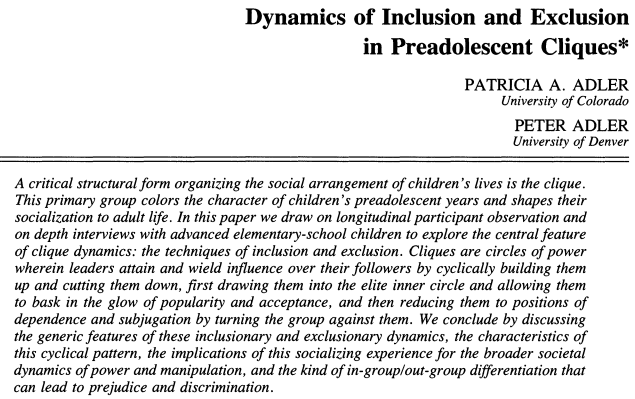
Research on Ingroups and Middle School Cliques
Patricia and Peter Adler studied adolescents extensively and they concluded that the creation of cliques happens cyclically even before middle school begins and these can lead to prejudice and discrimination. Here is one of  Patricia and Peter Adler's ethnographies and you can read the abstract below:


Outgroups and the war in Iraq
In this TED talk by sociologist Sam Richards, he explains how understanding outgroups might lead to a radical experiment in empathy. Check it out: