Thursday, October 6, 2022

3.2 Family

 As students enter, please review this NY Magazine piece about Carolyn Dweck's book, Mindset.

Lesson Focus:

What are the ways that family influences individuals? 
What are the ways that family is changing in the U.S.?
How does this research compare to your family?


Family; The Most Influential Agent of Socialization

Family is the most important agent of socialization. Family shapes our self-concept first and before we are even conscious of it.  Human brain development happens most rapidly and greatly in the first few years after birth.  This UNICEF website (2016) explains what experts have concluded about brain development.  Dr. Suzana Herculano-Houzel explains the latest conclusions in this 5 min video.  The point is that much growth and development happens in the earliest years of human life so our first caregivers have an enormous impact on who we become.

Some of the influences from family are intentional.  Sociologists call direct lessons that are consciously taught manifest lessons.  Conversely, latent lessons are lessons that you learn unconsciously.  An anecdotal example from my own life is about my dad smoking.

Manifest - Don't smoke.

Latent - Stand this way.


And another example is when I was in college and considering what jobs to do afterwards.  Besides teaching, I considered both the Chicago Police and FBI - both jobs that my parents did.  But they never influenced me to do those jobs in a manifest lesson, instead it was more latent - I heard them talk about those jobs and it swayed me to consider them.


Answer individually:
What are some ways that you are similar to your family? Is this latent or manifest?  Why?


Evidence for Family Socialization 
There is much evidence for how individuals are socialized to think about their "self".  Examine the evidence below from sociologists.

Family Dinner - Latent Lessons from the Dinner Table


Family Integration and Self-Esteem


Family shapes your "self"


How is Dweck's research an example of family's influence on "self"?

Carol Dweck explains how parents and eventually schools both work to create a fixed mindset that actually prevents learning.

This Atlantic article the latest update to Dweck's research which shows that praise cannot be empty.  It must be directed in specific nuanced ways to promote growth.

This NPR review of the book includes an excerpt and an interview.

This NY Magazine article explains how to apply Dweck's research to parenting and talking to kids.

Brain Pickings review of Dweck's Research provides a thorough explanation and a few quotes from the book.

Dweck explains her work on this TED Talk

and she explains how we can teach a growth mindset in this talk from Stanford U.
 

Cross-Cultural Example of Family and Production of Culture and the Self
Life Lessons from Chinese Culture from NPR shows how families influence kids to accept aspects of their culture. What are the hidden messages in the storybooks we read to our kids? That's a question that may occur to parents as their children dive into the new books that arrived over the holidays.
And it's a question that inspired a team of researchers to set up a study. Specifically, they wondered how the lessons varied from storybooks of one country to another.


Explain how you have been shaped by parents to have either a "growth mindset" or a "fixed mindset"? 


A lesson for parents from Angel Harris

Have you ever been in trouble for poor grades? You may want to read this research by Keith Robinson and Angel Harris.  
A main finding from our analyses is that a non-punitive parenting philosophy enhances future academic performance. It may be that non-punitive strategies are particularly effective because they create an optimal setting under which children can devote more attention to schooling. This setting, void of punitive restrictions on activities, might foster the intrinsic motivation necessary for improved performance (). It might also be that parents are re-organizing the way children spend their time, for example, suggesting (rather than explicitly demanding) they exchange some time spent on extracurricular activities for time on activities more essential for academic success. An exchange of this sort may involve spending fewer hours watching television or time alone in recreation, to more time studying with friends or attending after-school classes over the same number of hours. In this way, parents are not using punitive measures to adjust the way their child spends time, which might be the most effective way to motivate children academically.


Angel Harris is a widely respected sociologist from Duke University who focuses on the effects of family, race and social class on student education.  Harris's book Kids Don't Want to Fail explains the influences that limit poor minority students.  From Harvard University Press,


"Despite achieving less in school, black students value schooling more than their white counterparts do. Black kids perform badly in high school not because they don’t want to succeed but because they enter without the necessary skills. Harris finds that the achievement gap starts to open up in preadolescence—when cumulating socioeconomic and health disadvantages inhibit skills development and when students start to feel the impact of lowered teacher expectations. Kids Don’t Want to Fail is must reading for teachers, academics, policy makers, and anyone interested in understanding the intersection of race and education."


The Changing Structure of Family

1. If I told you that I live with my family, who would you assume I mean?

2. What are some other ways to define family different than above?


My family and I dressed up as the family from Despicable Me one Halloween.  This was one of my favorite costumes but it also is an interesting example of the changing family in the U.S.  Most often, when Americans think of "family" they think of the nuclear family - two heterosexual partners, married and their children.  Although this is an ideal in many Americans' minds, sociologists question whether or not it was ever a reality.  Most family researchers will trace this back to the post-WWII era when these types of families seemed to peak.  However, the romanticized notion may be from media that created an ideal image of this family even if the reality was much different then and certainly is now.


One sociologist who researched the American family extensively using historical methods is Stephanie Coontz who writes,
Leave It to Beaver was not a documentary, a man’s home has never been his castle, the ‘male breadwinner marriage’ is the least traditional family in history, and rape and sexual assault were far higher in the 1970s than they are today. In The Way We Never Were, acclaimed historian Stephanie Coontz provides a myth-shattering examination of two centuries of the American family, sweeping away misconceptions about the past that cloud current debates about domestic life. The 1950s do not present a workable model of how to conduct our personal lives today, Coontz argues, and neither does any other era from our cultural past. This revised edition includes a new introduction and epilogue, looking at what has and has not changed since the original publication in 1992, and exploring how the clash between growing gender equality and rising economic inequality is reshaping family life, marriage, and male-female relationships in our modern era.

Here is a review of Coontz's book from the New Republic.

Here is a review of her work on Goodreads.


Family Structure in the U.S. is Changing

From the PEW Research Center, Trends Shaping the US (2017):

Americans’ lives at home are changing. Following a decades-long trend, just half of U.S. adults were married in 2015, down from 70% in 1950. As marriage has declined, the number in cohabiting relationships (living with an unmarried partner) rose 29% between 2007 and 2016, from 14 million to 18 million. The increase was especially large among those ages 50 and older: 75% in the same period. The “gray divorce” rate – divorces among those 50 and older – roughly doubled between 1990 and 2015.

Also, a record number of Americans (nearly 61 million in 2014) were living in multigenerational households, that is, households that include two or more adult generations or grandparents and grandchildren. Growing racial and ethnic diversity in the U.S. helps explain some of the rise in multigenerational living. The Asian and Hispanic populations overall are growing more rapidly than the white population, and those groups are more likely than whites to live in multigenerational family households.

Americans are more accepting of the changing structures than they have ever been. 

As family structures change in U.S., a growing share of Americans say it makes no difference
The American family is changing in many ways: Cohabitation is on the rise, more adults are delaying or forgoing marriage, a growing share of children are living with an unmarried parent, and same-sex marriage is legal in all 50 states.  Amid these changes, three-in-ten U.S. adults think it’s a good thing that there is growing variety in the types of family arrangements people live in, while about half as many (16%) say this is a bad thing. The largest share (45%) don’t think it makes a difference, according to a Pew Research Center survey conducted in June 2019.

Here is a graph from Phil Cohen showing different types of households by decade 1900-2017:


3.  What conclusions can you make from the graph?


The share of adults who have lived with a romantic partner is now higher than the share who have ever been married; married adults are more satisfied with their relationships, more trusting of their partners 

Wendy Manning, Susan Brown and Krista Payne find that, among young adults, cohabitation no longer offsets the decline in marriage because cohabitation has plateaued. This cohabitation stall portends a shift to lower levels of overall union formation during young adulthood and may presage declining levels of marriage and cohabitation into middle age. Further, our findings call into question the widely accepted notion that the U.S. is on a path to reach the nearly universal levels of cohabitation observed in Western Europe. In the U.S., if current trends among young adults continue across age groups, cohabitation will no longer supplant marriage. Women will be less likely to form any union instead.

Size of Households
The number of people in the average U.S. household is going up for the first time in over 160 years.  This decade’s likely upturn in average household size reflects several demographic trends:
  • A growing share of the population resides in multigenerational family households.
  • More Americans in the wake of the Great Recession are “doubled up” in shared living quarters.
Related to the size of households,  this report from Pew explains that a majority of young adults in the U.S. live with their parents for the first time since the Great Depression  The coronavirus outbreak has pushed millions of Americans, especially young adults, to move in with family members. The share of 18- to 29-year-olds living with their parents has become a majority since U.S. coronavirus cases began spreading early this year, surpassing the previous peak during the Great Depression era.


Trends in Divorce


(Legal marriage age is determined by state laws see here for more and the graphic below)


4.  What demographic is most likely to divorce according to the graphs above?  What other conclusions can make from the graphs above?


Americans and Interracial Marriage


Other trends from the Pew Research Center on Family and Relationships and  Family Roles, Household/Family Structure and Intermarriage including these:

Sharing household chores is an important part of marriage for a majority of married adults. But among those who have children, there are notable differences in perceptions of who actually does more of the work around the house.

More than half of married couples in the United States say sharing household chores is “very important” to a successful marriage. But when it comes to grocery shopping and cooking, women tend to say they’re the ones usually doing the work, according to a time-use survey sponsored by the Bureau of Labor Statistics (BLS).

C.  How American parents balance work and family life when both work
Today’s American families are more likely than those of past decades to feature two full-time working parents. A new Pew Research Center report looks at how working moms and dads in two-parent households are balancing their jobs with their family responsibilities and how they view the dynamics of sharing child care and household responsibilities.

D.  As Millennials Near 40, They’re Approaching Family Life Differently Than Previous Generations
A new analysis of government data by Pew Research Center shows that Millennials are taking a different path in forming – or not forming – families. Millennials trail previous generations at the same age across three typical measures of family life: living in a family unit, marriage rates and birth rates.

 E. School Outcomes of Children Raised by Same-Sex Parents: Evidence from Administrative Panel Data  These data include 2,971 children with same-sex parents (2,786 lesbian couples and 185 gay male couples) and over a million children with different-sex parents followed from birth. The results indicate that children raised by same-sex parents from birth perform better than children raised by different-sex parents in both primary and secondary education. Full article here.


Choose one of the above articles from the PEW that looks interesting.  Answer the questions below:  

6.  Which article did you choose?

7. After reading it, do you think the findings are interesting?

8.  What is either one finding you think is interesting or one criticism of the article?

9. Is this true for your family or families that you know?


Extra Resources about the changing family:

Cohabitation in Chicago Tribune
Seven percent of U.S. adults are currently cohabitating, and among that 7%, the fastest growing cohort consists of people 50 and older. Kevin McElmurry, Indiana University Northwest quoted in Chicago Tribune (2019)


Professor Medley-Rath from Sociology In Focus
In this post, Stephanie Medley-Rath discusses a few growing trends in family structure.
Medley-Rath covers data and changing families in these areas:
  • Cohabitation
  • Remaining Single Longer
  • Unmarried Parents
  • Living with Mom and Dad

Census Bureau and Changing Family

And from the Census Bureau, there is this data exercise which shows family changing.  The Census Bureau published this news release explaining the data.  


Wednesday, September 28, 2022

Undergrad Job Opportunity


My name is Ben Stringer, I’m currently in the SOCL department’s BA/MA program and I was wondering if you would be willing to pass along some information my job is sending around. MAPSCorps works with high school aged students from primarily Chicago’s South and West sides. Their afterschool and summer programs introduce students to the research process, data science and data analytics.


Link to apply: https://mapscorps.applytojob.com/apply/DbSRPf1D9o/Research-Instructor  

I also attached a flyer and screenshot of MAPSCorps mission section of their website.

Anyone that’s interested is welcome to reach out to me at ben.stringer@mapscorps.org


Thursday, September 15, 2022

Assessment for Unit 1: The Sociological Perspective

Below are the directions for this assessment:

This first unit has been all about how sociologists see the world, or the sociological perspective. For this first assessment, you are required to write an essay that examines your own life from a sociological perspective. Here is the prompt:

Explain the sociological perspective and use examples from your own life to write an authentic essay.

In order to make the assessment easier, break it down into smaller parts/paragraphs.  (This essay should have four parts/paragraphs), but you will submit each part/paragraph separately.

1.  Explain the focus of this unit - what is a sociological perspective? How do sociologists view the world? How can this make you more mindful?  Be specific - try to connect the sociological perspective to your own life and how you may be thinking with a sociological perspective since our class began.
2.  Explains one of the theories. What is the theory? Explain it and give unique example from your own life.  How can this theory apply to your life and make you more mindful?
3.  Explain one of the paradigms.  What is the paradigm? Explain it and give a unique example from your own life.  How can this paradigm apply to your life and make you more mindful?
4.  Explain another paradigm of your choice.  What is the paradigm? Explain it and give a unique example from your own life.  How can this theory apply to you and make you more mindful?
 
As a reminder, we learned about 2 theories and 3 paradigms:

Theories
Social Construction of Reality
Sociological Imagination

Paradigms
Structural-Functional
Conflict
Symbolic Interaction 


Suggestions and tips:

  • I recommend that you write your essay in Google docs or an app that will save your work and allow you to edit it.  Then, when you are finished submit the assessment here.
  • Use proper grammar and prose. Spell check and proofread. Turn it in by the starting time of our next class. This is the due date whether or not you are present in class that day.  If you have trouble uploading it, you can find me at the beginning of class and let me know that you are having difficulty. 
  • Have a well developed paragraph for EACH of the 3 paradigms/theories you choose. That paragraph should: 

1.  First, explains what is the paradigm/theory and how is it different than the other paradigms/theories. How does the theory/paradigm help to develop a sociological perspective?
2.  Apply the paradigm/theory to a unique example from your own life or perspective.  Throughout our lessons, I have asked you to apply the theories to your own examples, for example your name or going to college. You may use these examples as long as they are unique to you. Your writing should be authentic - which means that it only applies uniquely to yourself.  

 You will be graded using the following rubric:

10-1 Academic Standards:  Was it turned in on time? Was it written properly and understandably? Was spelling, grammar, and punctuation correct?

10-1 Introduction: Did you explain, in general, the sociological perspective (how sociologists view the world)?  Did you connect it to your own life/perspective and perhaps how you have been viewing the world differently in any ways since our class began?

10-1 Theory: Was the theory explained fully?  Was the applied example(s) authentic and detailed based on the student's own perspective?

10-1 Paradigm #1: Was the theory explained fully?  Was the applied example(s) authentic and detailed based on the student's own perspective?

10-1 Paradigm #2: Was the theory explained fully?  Was the applied example(s) authentic and detailed based on the student's own perspective?
 

Finally - I will hold extended office hours for this first paper.  If you can email me, it would be helpful, but I will be available on campus:  after class Thursday until 11:45; Friday from 9:15 - 11:45; Monday 9:15-11:45.  


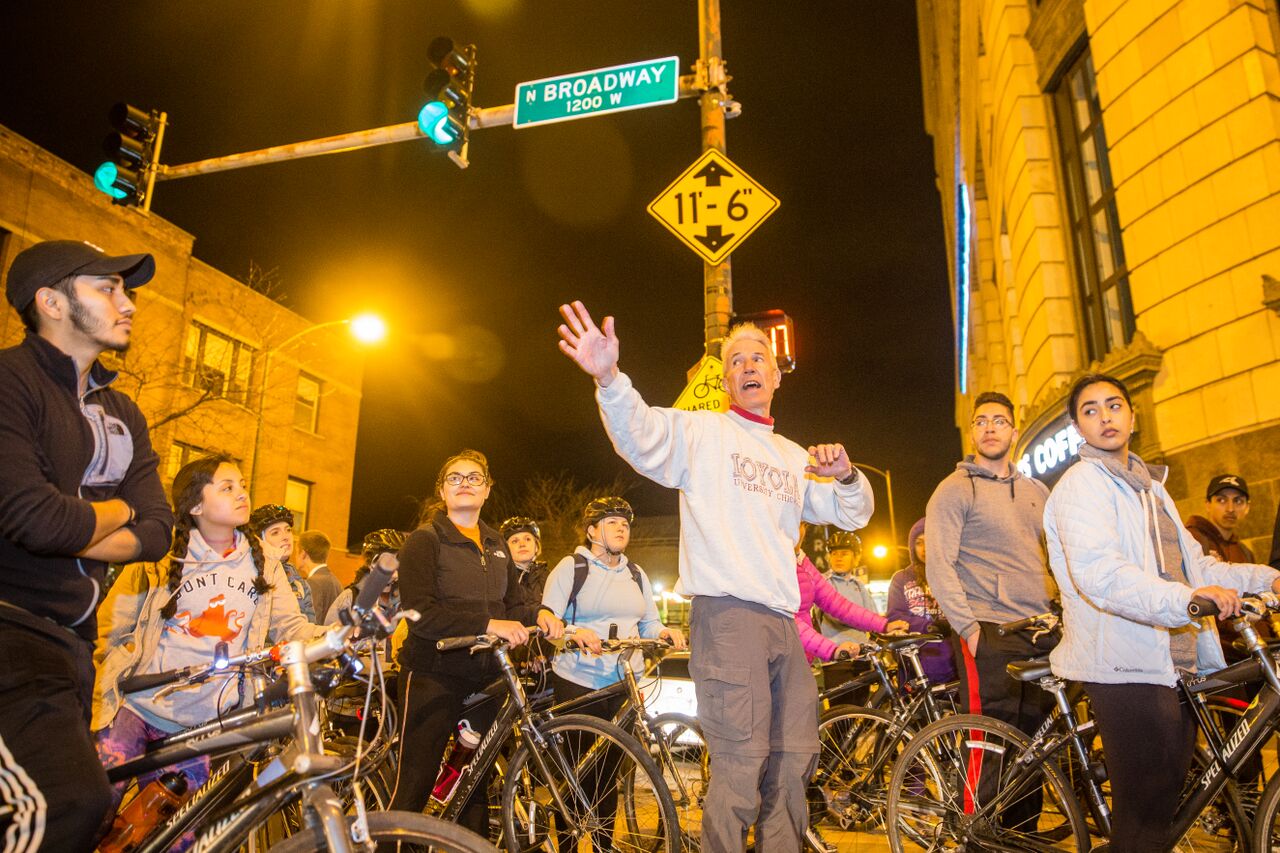
Tonight: Professor Gilfoyle's Midnight Ride!

 From the LUC webpage:

The Midnight Bike Ride will ride again on September 15, 2022, beginning at 9 pm. 

Hog Butcher for the World,
Tool Maker, Stacker of Wheat,
Player with Railroads and the Nation's Freight Handler;
Stormy, husky, brawling,
City of the Big Shoulders.
-Carl Sandberg 


The next Midnight Ride is scheduled for Thursday, September 15, 2022.

Since 1989, Loyola University history professor Timothy Gilfoyle has conducted a "midnight bike ride" for his students and friends. The event introduces students to major themes in American history by visiting various historic sites in Chicago. 

A Brief Introduction to the Midnight Bike Ride: https://www.youtube.com/watch?v=rslSQGO2PAI​ 

Check out highlights from the Fall 2017 Midnight Bike Ride on the YouTube Series "I Am Your Neighbor."

The adventure returns at 9 pm on September 15, 2022 in the plaza just south of the East Quad and bounded by Cuneo Hall, Madonna della Strada Chapel, and Mundelein Center on the Lake Shore Campus of Loyola University. Riders normally return to campus between 6 a.m. and 7 a.m. the following day. The ride takes place in the late evening and morning hours in order to avoid daytime and rush-hour traffic and because participants always see and learn more on a bike than during a bus ride or walking tour. Riders pedal at a leisurely pace (this is not a race), frequently stopping at important historical and architectural sites. Pit stops to eat, drink, and visit the rest room are frequent. All Loyola students, faculty and alumni are invited, and they are encouraged to bring family and friends.

Participants are urged to dress warmly, preferably wearing layers of clothing in order to adapt to the frequently changing Chicago weather. Gloves are also recommended in the event of cold weather, particularly in the early morning hours. Participants should bring money to pay for food and drink, and are also required to sign a legal waiver of release prior to the ride.

Don’t have a bike?  No problem! Loyola students may rent bikes for $35 (discounted from the regular $45 charge) from Chainlinks located at 1100 W. Sheridan Road on the ground level in the Parking Structure next to Campus Transportation on the Lake Shore Campus. A sign is displayed in the entry way to the garage with Chainlink's name on it.  Bike reservations are available online at www.chainlinksluc.com/rent-a-bike.  Renters need to have a valid driver’s license or student ID and payment must be made before pick up through Loyola's Marketplace portal.  Chainlinks requires students to reserve a bike online in advance to expedite the rental process.  Finally, daily rentals are valid for 24 hours: if a rental is picked up at 8pm, the bike should be returned the following business day at 8pm.

Past bike rides have visited the following places:


DATES OF UPCOMING BIKE RIDES

September 15, 2022

April 20, 2023

September 14, 2023

Back to Timothy Gilfoyle

Wednesday, September 14, 2022

Max Weber and Symbolic Interaction Paradigm

 Max Weber and Symbolic Interaction Paradigm


Max Weber's contribution to the development of sociology during the Industrial Revolution

Max Weber (pronounced VAY-ber) studied the development of capitalism in European countries.  He found that countries that became more Protestant also became more capitalist.  This is peculiar because religion and economics seem to be separate.  But Protestants held shared meaning with each other about their wealth and finance.  They saw living within their means and investing their money as signs that they were living righteously within their Christian beliefs.  This created an economy that was based on investment.  It led to the creation and expansion of capitalism, investing profit to make even more profit.   It might seem strange for religion to be connected to the economy, but in their interaction with each other, it was real for them.  


The development of the Symbolic Interactionist paradigm 

Building off of Weber's work, two sociologists created a third paradigm for which sociologists view the world.   Weber showed symbolic meaning in the Protestants' lives and in their everyday interaction with other people.  Stemming from Weber's work, George Mead, W. I. Thomas and Herbert Blumer focused on the shared meaning in everyday life between people.  This paradigm became known as Symbolic Interaction.  It is more focused on face-to-face interaction, or small groups, as opposed to large-scale institutions.  Much of our interaction with each other holds symbolic meaning to us.  The words we use, our body language, our clothes all hold symbolic meaning for us.  They convey an identity we have to the world. 

How can you use Weber's Symbolic Interaction paradigm to analyze our lifeboat simulation?

How can you apply Weber's Symbolic Interaction paradigm to college?


Symbolic Interaction paradigm and names

An example of Symbolic Interaction can be seen through names.  A name isn’t just a random set of syllables.  Names have symbolic meanings that are shared among people, even strangers, within a society.  For example, see the multiple examples below about the ways that names can have shared meaning. 

Names hold important meanings that we might realize at first.  

According to the authors of Conventional Wisdom Tells Us..., what are some examples of the different meanings that names hold?  

What are some ways that Cerulo and Ruane show these meanings affect people?

Baby Names follow trends
Some students will say that their parents just chose the name because they liked it.  But closer research reveals that for many names that parents seemed to "just like," there was a larger meaning behind why parents liked the name.  A respected sociologist from Harvard named Stanley Lieberson studied trends and fashions.  He used the Social Security Names database to study how names spread in popularity similar to how fashion spreads.  You can read this NY Times article (or download it here) about the details of what Lieberson found, but in short, the naming of new babies is not simply personal:
  • Name choices, like clothing choices, reflect the desire to be different, but not too different.
  • Names branch off of each other with similar suffixes or prefixes 
  • Names reflect societal patterns like immigration patterns
  • Names are changing more frequently than they used to reflect a stronger desire to be different.
Try your own research with the SSA Baby Name Database.  
Notice that the data shows that names go in and out of style, even if we don't notice it.  For example, my parents named me Christopher, but they just thought that they liked the name.  Looking at the data, it is now evident that Christopher was the second most popular name that year! 

Try find examples of any of Lieberson's finds in the SSA Baby Name Database?  Give a specific example.


Names also hold shared meaning because culture assigns meanings to ideas
For more on names and symbolic meanings, you can listen to the Freakonomics podcast episode by Wells, Katharine.  How Much Does Your Name Matter? Freakonomics Radio Podcast. April 8, 2013.
The episode draws from a Freakonomics chapter called “A Roshanda By Any Other Name”and includes a good bit of new research on the power of names. It opens with a conversation with NYU sociologist Dalton Conley and his two children, E and Yo. Their names are a bit of an experiment.  Indeed, there is some evidence that a name can influence how a child performs in school and even her career opportunities. There’s also the fact that different groups of parents — blacks and whites, for instance — have different naming preferences. Stephen Dubner talks to Harvard professor Latanya Sweeney about a mysterious discrepancy in Google ads for Instant Checkmate, a company that sells public records. Sweeney found that searching for people with distinctively black names was 25% more likely to produce an ad suggesting the person had an arrest record – regardless of whether that person had ever been arrested.  Names do, however, reveal a lot about the people doing the naming. Eric Oliver, a political scientist at the University of Chicago, talks about his new research (with co-authors Thomas Wood and Alexandra Bass) that looks at how children’s names are influenced by their parents’ political ideology.
If names do affect their bearers' chance of success, it may not always be because of the reactions they cause in other people (the "looking-glass self"), they might also be because of "implicit egotism", the positive feelings we each have about ourselves.  Brett Pelham cites the concept in explaining his finding that individuals called Virginia, Mildred, Jack and Philip proliferate in Virginia, Milwaukee, Jacksonville and Philadelphia - he believes they are drawn to live there.  


Kerry Wood of the Cubs logged 20 strikeouts in a single game in 1998!


Another intriguing 2007 paper, entitled Moniker Maladies, found that people's fondness for the initials of their names could get in the way of success. Leif Nelson and Joseph Simmons analysed almost a century of baseball strikeouts and found that hitters with the initial K had a higher strike-out rate ("K" denotes a strike-out in baseball). They also found that graduate students with the initials C and D had a slightly lower grade point average than A and B students, and A and B applicants to law school were more likely to go to better colleges.


Branding as Shared Meaning

Think about the meaning that people share about the things below.  What meaning do they hold? Who shares the meaning? How does that meaning influence our reactions?  How does the meaning get reinforced and/or re-interpreted by society?


Look at the shoes above from StockX.  The prices listed are the prices people bid on the shoes (not the asking price).  In other words those are prices that people are willing to pay!

Why would people pay that much?  What does owning these shoes mean/represent?

How did this meaning come to be?  Look at the following sites that explain how the creation of meaning happened to the Air Force Ones:


"Teenager" and shared meaning
What are the shared meanings that the label "teen" might hold for parents?  For society?  

How might the label of "teen" affect the face-to-face interactions between teens and parents, teachers, peers?   How did this meaning come about?


Do you understand how sociologists view the world through a symbolic interaction perspective?  Any questions about that paradigm?

    Individually:
    Look at your answer for what you are proud of and what your various goals are.  Choose one of these answers and think about the larger meaning behind your answer.  Why are you proud of that or why is it a goal?  What does it symbolize to you and how do you hope others view it? 


    Small Group:
    Compare your answer above to those in your small group.  What similarities emerge? Do others in your group agree with your answer for number 1 above?  (In other words, do they share the same meaning/understanding as you about those achievements/goals?)