Tuesday, July 2, 2024

Cook County Community Survey

The Cook County Community Survey is a new survey in partnership with Loyola to provide data about public opinion throughout Cook County, IL.   The data can be disaggregated by city v. suburb, race, gender, age, education, income.

EXPLORE the DATA

PURPOSE

The Cook County Community Survey is a collaborative effort that brings together faculty, graduate students, and undergraduate students to shed new light on the attitudes and behaviors of residents of Cook County. The project is housed under Loyola University Chicago's Center for Data Science and Consulting.

The survey is funded by generous support from the Leibman family.  

Working Together
METHODOLOGY

The Cook County Community Survey has been fielded annually since 2021. Each year, students and faculty participants worked together to develop the survey in Qualtrics. Respondents are recruited by sampling firms to complete the survey online. The firms we work with seek to provide a pool of respondents who are demographically representative of adult residents of Cook County.

Students work with faculty advisors to analyze the data and write up findings. Findings from the surveys have been presented at academic conferences, in  press releases, and in  scholarly publications.  

Monday, July 1, 2024

A History of High School Sociology and CAST


High School Sociology and Chicago Area Sociology Teachers (CAST) 


The Chicago Area Sociology Teachers (CAST) began organically out of a need to create professional development for high school sociology teachers. Most high school social studies teachers have to teach multiple different social studies classes.  The most common and consistent classes are US history and government.  Then teachers might be assigned some combo of other elective courses such as geography, economics, psychology or sociology.  So, for social studies most teacher education programs are focused on history and so is the professional development (pd) that comes as part of continuing teacher education (CTE).  One exception is Advanced Placement (AP) courses which are supplemented by the College Board. This means that professional development is difficult to find for tertiary courses that are not required and not AP level.  Additionally, because sociology is on the periphery, most high schools that offer sociology only have one teacher in the building who teaches it - there is no one for them to collaborate with.


The Beginning

Fortunately, in 2003, DePaul U hosted a regional meeting of sociology (MSS or NCSA) and there was a session on teaching sociology.  A handful of high school teachers showed up to that session.  After the session, we exchanged emails and agreed that it was helpful to share ideas with other sociology teachers.


The following year, Hayley Lotspeich from Wheaton North High School organized a meeting for our small network in a free conference room in the basement of a bank.  Less than a dozen of us met at that first meeting, but it felt so great to be with our sociological compatriots and the practical ideas we shared were so helpful.  We were absolutely committed to meet like that again.  Hayley gathered email addresses, and contacted department chairs in the nearest two counties to spread the information to their sociology teachers who had not attended the conference.  A major obstacle for the group was selecting a time after school that everyone was available.  Many teachers coach, sponsor activities in the building, participate in building committees, and have day care issues.  It became clear that there were more teachers who wished to participate, so to include everyone, the group would need to meet during the school day and for a very low or free cost. 


CAST

With the success of the first couple meetings, it was clear that this was a valuable opportunity that teachers were energized about.  We brainstormed ideas for a name and the Chicago Area Sociology Teachers (CAST), was created.  Hayley was able to get space at her high school so that the group could meet in a larger space during a school day.  Christopher Salituro from Stevenson High School created a Google Group listserv so that we could follow up and continue to share with each other in between our meetings. Year to year the group grew and so did the Google Group listserv. Hayley even collaborated with students to create the logo for the group.


The annual meeting continued to thrive with Hayley's dedication and organization.  Generally, each meeting was a continental breakfast from 8-8:30 followed by some brief remarks about the group and other relevant happenings in sociology.  Then, there was a keynote speaker (usually found by Hayley) who would engage and enrich our understanding of sociology by simply explaining their work.  Some of the speakers over the years included: domestic violence case worker, Homeless Veterans Outreach, WE Schools community service, Chicago Police officer and investigator, director of shelter for victims of sex trafficking, homeless outreach, World Relief refugee resettlement coordinator, chaplain from Dupage Jail,  UIC Institute for Research on Race and Public Policy and Tonika Johnson's Folded Map Project, Judson Everitt Undergraduate Director from Loyola University Sociology Department, and Dana Garbarski from the Cook County Community Survey. Finally, the third session of the day was a roundtable lesson sharing where every participant brought one lesson/reading/activity.  The teachers give a brief explanation of what they brought - what unit they teach it in, why they like it, what pitfalls to avoid, etc...  This is usually the bulk of the conference lasting about 2 hours.  Usually a lunch is included and it can be a working lunch to continue the session if need be.  The conference has continued to be minimal cost, just enough to cover lunch, snacks and any printing/paper.


ASA

In 2007, Hayley and Chris reached out to the American Sociological Association (ASA) to let them know about the work we were doing and see if they could provide more support for high school sociology.  Specifically, we wanted to see if there was institutional support for an AP course, but generally we wanted to promote high school sociology and garner resources for our growing group.  ASA put Margaret Weigers Vitullo (Director of Academic and Professional Affairs) and Jean Shin (Director of Minority Affairs) in touch with us.  They flew out to see the annual meeting and were really impressed with the large and vibrant group of sociology teachers.


Maragaret and Jean started to collaborate with Hayley and Chris informally and in 2007 CAST was featured in an issue of the ASA's newsletter Teaching and Learning Matters.  By 2009, the ASA sponsored members of our group to present at the National Council for Social Studies (NCSS). Soon after, the ASA formalized their partnership by creating the High School Advisory Board.  Hayley Lotspeich was the Director of the High School Advisory Board and Chris was the Assistant Director and Margaret and Jean collaborated on the board with them. The group was small, but it had a seat at the table and had both institutional support and a small budget from the ASA.  


The first couple of years, the ASA had a special session at the ASA annual meetings. In 2011 we presented at ASA in Las Vegas and in 2012 we presented at ASA in Denver. We spent a lot of time reaching out to local schools to promote the conference to high school sociology teachers.  But the ASA annual meeting's date was a difficult time for many high school teachers because it fell during the first week or so of school.  Hayley and Chris worked with the ASA to create a session at NCSS, the preeminent professional development conference for K-12 social studies teachers.  NCSS agreed to create a symposium which featured a contiguous 3 session series organized by the ASA High School Advisory group.  We usually structured the series with a couple sessions about teaching sociology concepts followed by a session from a scholar who highlighted their work in the field including: Harel Shapira, Dennis McSeveney, Angel Harris, Ness Sandoval, Lynette Hoelter, Laura Beth Nielsen, and Arlie Russell Hochschild.  We also presented at NCSA in Chicago (2010), and Indianapolis (2013).  


Standards and AP

In 2013, the push for common core standards was already in full swing. The NCSS was already working on the social studies version of common core standards called College, Career and Civic Life Standards (C3).  NCSS asked us to create a sociology appendix with C3 standards for high school sociology.


While presenting at various conferences with the ASA, we also set a goal to make a push for AP sociology once again.  The conferences were creating a network of high school sociology teachers from around the country, which showed the interest for AP sociology was there, so we turned our attention to the course.  We felt that in order to create a course that was advanced, we had to establish what the standard for the course should be.  The ASA High School Advisory Board convened a working group to create national standards for sociology.  The group consisted of representatives from the ASA, high school and higher education and published the  National Standards for High School Sociology in 2015.


With a listserve of over 300 teachers and National Standards for High School Sociology the ASA High School advisory board appealed to the ASA board to approach the College Board about an AP sociology course.  In 2017, Michele Lamont (Harvard) reached out to the college board but was continually rebuffed by Trevor Packer.


Dual Credit

In 2017 Chris partnered with Loyola University Chicago to create a dual-credit sociology course through Loyola University for Stevenson High School Students.  Hayley partnered with Indiana University's Advanced College Project to offer dual credit to Wheaton North High School Students.  


In 2018, Hayley and Chris collaborated with MSS and NCSA to host a teaching workshop at the the joint meeting of MSS/NCSA in partnership with AKD represented by Jeffery Chin.  This was in downtown Chicago but due to space and cost, Loyola University's sociology department led by Anne Figert agreed to host our portion of the meeting at their downtown (Watertower) campus.  


In 2020, as Covid was shutting down all in person gatherings, the ASA restructured their organization.  Among quite a few personnel changes, ASA also decided that the High School Advisory Board should become like the other communities at ASA with an elected board. As of 2024, it remains unclear if there is any leadership for this community or if it is simply a tab on the ASA webpage.


In 2022, Hayley and Chris both applied and were accepted to be a part of an ASA high school resource workshop group to create lessons that support the National Standards. These resources are posted on the ASA website.


Loyola Partnership

In 2022, Chris left his teaching job at Stevenson High School and became an adjunct professor of sociology in-person, on campus for Loyola U's undergraduate sociology department.


In 2023, the Loyola Sociology Department agreed to host the CAST conference on their Lakeshore Campus.


Wednesday, June 26, 2024

Uptown Chicago

From Robert Lorezal's online history of Uptown; The Coolest Spot in Chicago.


 The Uptown Theater: Palace of Dreams by Robert Lorezal,

“It outdoes your dreams,” the advertisements declared. “IT WILL HUSH AND THRILL YOU. It throbs with beauty—lovely enough to hold the heart of a woman all her life. You will love it.”

These ads were promoting the grand opening of the Uptown Theatre on August 18, 1925. “Magnificence beyond all your dreams—rising in mountainous splendor and might—an enchanted palace—a house of magic beauty. …  Great and beautiful as a magic city—AN ACRE OF SEATS under a romantic and color-lit twilight from myriads of unseen lamps. … One of the great art-buildings of the world—and in it, room for everybody! … It opens Tuesday! … an event you will remember all your life…”1

With 4,381 seats, it was the world’s largest cinema at the time2—and to this day, it stands as one of the grandest movie palaces ever constructed. “A Palace of Dreams is right!” the Chicago Herald and Examiner’s Polly Wood wrote after attending the opening festivities. “You can completely believe the advertisements.”3

A reporter for Variety was also blown away by the Uptown Theatre’s magnificence, writing: “Eclipsing in size, splendor and impressiveness anything that has been built in the last few years of hectic theatre construction, this new house is not only beyond doubt the most gorgeous movie palace in the world, but is so far above its neighborhood that the North Side will be years before it is worthy of it.”4

Loneliness, health and a solution in neighbors and planning

 From Retro Report:

Even before the Covid pandemic shut down schools, closed businesses and introduced the idea of social distancing, medical experts were seeing an alarming increase in Americans struggling with isolation. The U.S. surgeon general has called this trend an epidemic of loneliness, as harmful to health as smoking cigarettes. Now some Americans are embracing a collaborative living arrangement called cohousing as a solution.


Lesson Plan

Student Activity

Additional resources

The Birth of Gospel in Chicago

From WTTW:  https://interactive.wttw.com/chicago-stories/birth-of-gospel/the-birth-of-gospel-music-in-chicago


Polish Museum of America

 Polish Museum of America


Wednesday, June 19, 2024

Juneteenth


From Heather Cox Richardson:

Today is the federal holiday honoring Juneteenth, the celebration of the announcement in Texas on June 19th, 1865, that enslaved Americans were free. 

That announcement came as late as it did because, while General Robert E. Lee surrendered his Army of Northern Virginia to General Ulysses S. Grant of the U.S. Army on April 9, 1865, it was not until June 2 that General Edmund Kirby Smith surrendered the Trans-Mississippi Department, the last major army of the Confederacy, to the United States, in Galveston, Texas. Smith then fled to Mexico. 

Seventeen days later, Major General Gordon Granger of the U.S. Army arrived to take charge of the soldiers stationed in Texas. On that day, June 19, he issued General Order Number 3. It read:  

“The people of Texas are informed that, in accordance with a proclamation from the Executive of the United States, all slaves are free. This involves an absolute equality of personal rights and rights of property between former masters and slaves, and the connection heretofore existing between them becomes that between employer and hired labor.” 

Granger’s order was not based on the Thirteenth Amendment to the Constitution, which abolished enslavement except as punishment for a crime. Although Congress had passed that amendment on January 31, 1865, and Lincoln had signed it on February 1, the states were still in the process of ratifying it. 

Instead, Granger’s order referred to the Emancipation Proclamation of January 1, 1863, which declared that Americans enslaved in states that were in rebellion against the United States “shall be then, thenceforward, and forever free; and the Executive Government of the United States, including the military and naval authority thereof, will recognize and maintain the freedom of such persons.” Granger was informing the people of Galveston that, Texas having been in rebellion on January 1, 1863, their world had changed. The federal government would see to it that, going forward, white people and Black people would be equal.

Black people in Galveston met the news Order No. 3 brought with celebrations in the streets, but emancipation was not a gift from white Americans. Black Americans had fought for the United States and worked in the fields to grow cotton the government could sell. Those unable to leave their homes had hidden U.S. soldiers, while those who could leave indicated their support for the Confederacy and enslavement with their feet. They had demonstrated their equality and their importance to the United States. 

The next year, after the Thirteenth Amendment had been added to the Constitution, Texas freedpeople gathered on June 19, 1866, to celebrate the coming of their freedom with prayers, speeches, food, and socializing. By the following year, the federal government encouraged “Juneteenth” celebrations, eager to explain to Black citizens the voting rights that had been put in place by the Military Reconstruction Act in early March 1867, and the tradition of Juneteenth began to spread to Black communities across the nation.

But white former Confederates in Texas were demoralized and angered by the changes in their circumstances. “It looked like everything worth living for was gone,” Texas cattleman Charles Goodnight later recalled. 

In summer 1865, as white legislators in the states of the former Confederacy grudgingly ratified the Thirteenth Amendment, they also passed laws to keep freedpeople subservient to their white neighbors. These laws, known as the Black Codes, varied by state, but they generally bound Black Americans to yearlong contracts working in fields owned by white men; prohibited Black people from meeting in groups, owning guns or property, or testifying in court; outlawed interracial marriage; and permitted white men to buy out the jail terms of Black people convicted of a wide swath of petty crimes, and then to force those former prisoners into labor to pay off their debt.

At the same time, those determined to preserve their power began to rewrite the history of the Civil War. The war had irrevocably undermined the institution of enslavement in the American South, moving it far beyond the ability of white southerners to reinstate it (although some historians argue that without the Thirteenth Amendment enslavement might have moved into the western mines). So white supremacists began to claim that secession had never been about slavery, despite the many declarations of secession saying the opposite. With the Freedmen’s Bureau, created by Congress in March 1865, defending the rights of Black Americans, certain white southerners began to claim that their “cause” had been to protect the rights of the states against a powerful federal government that was forcing on them a way of life they opposed. 

In the 1820s, before he became president, Andrew Jackson argued that true democracy meant honoring the votes of those in the states rather than laws made by Congress. This idea justified minority rule. Under this argument, a state’s voters could choose to take the land of their Indigenous neighbors or enslave their Black neighbors even if the majority of Americans, speaking through Congress, opposed those policies, because what mattered was the local vote. Crucially, states also decided who could participate in voting, and before the Civil War, the body politic was almost exclusively white men.  

The Black Codes were a clear illustration of what that system meant. Congress refused to readmit the southern states with the codes, and in 1866, congressmen wrote and passed the Fourteenth Amendment to the Constitution. Its first section established that “All persons born or naturalized in the United States, and subject to the jurisdiction thereof, are citizens of the United States and of the State wherein they reside.” It went on: “No State shall make or enforce any law which shall abridge the privileges or immunities of citizens of the United States; nor shall any State deprive any person of life, liberty, or property, without due process of law; nor deny to any person within its jurisdiction the equal protection of the laws.” 

That was the whole ball game. The federal government had declared that a state legislature—no matter who elected it or what voters called for—could not discriminate against any of its citizens or arbitrarily take away any of a citizen’s rights. Then, like the Thirteenth Amendment before it, the Fourteenth declared that “Congress shall have the power to enforce, by appropriate legislation, the provisions of this article,” strengthening the federal government.

The addition of the Fourteenth Amendment to the Constitution in 1868 remade the United States of America.

But those determined to preserve a world that discriminated between Americans according to race, gender, ability, and so on, continued to find workarounds. Key to those workarounds has always been resurrecting the idea that true democracy means reducing the power of the federal government and centering the power of the state governments, where voters—registered according to state laws—can choose the policies they prefer…even if they are discriminatory. 

In our era, those discriminatory policies are not just racial. They often center religion and include attacks on women’s healthcare and right to abortion, LGBTQ+ Americans, immigrants, and non-Christians. Just today, Louisiana governor Jeff Landry signed into law a measure requiring that every classroom in Louisiana public schools display the Ten Commandments. Those embracing the law hope to push the question of public displays of their faith to the Supreme Court, where they expect a warmer reception from this court than such discriminatory positions have gotten since the 1950s. 

If states get to determine who votes and can pass discriminatory legislation without interference by the federal government, they can construct the kind of world Americans lived in before the Fourteenth Amendment. As several Republican-dominated states have already demonstrated, they can also rewrite history. 

In 1865, Juneteenth was a celebration of freedom and the war’s end. In 1866 it was a celebration of the enshrinement of freedom in the U.S. Constitution after the Thirteenth Amendment had been ratified. In 1867, Juneteenth was a celebration of the freedom of Black men to vote, the very real power of having a say in the government under which they lived.  

In a celebration of Juneteenth on June 10, 2024, Vice President Kamala Harris noted: “Across our nation, we witness a full-on attack on hard-fought, hard-won freedoms and rights, including the freedom of a woman to make decisions about her own body; the freedom to be who you are and love who you love openly and with pride; the freedom from fear of bigotry and hate; the freedom to learn and acknowledge our nation’s true and full history; and the freedom that unlocks all others: the freedom to vote.”

Notes:

https://www.nytimes.com/2024/06/19/us/louisiana-ten-commandments-classrooms.html

https://www.archives.gov/news/articles/juneteenth-original-document

J. Evetts Haley, Charles Goodnight: Cowman and Plainsman (1949; rpt. University of Oklahoma Press, 1981).

https://www.archives.gov/milestone-documents/13th-amendment

https://www.archives.gov/milestone-documents/14th-amendment

https://avalon.law.yale.edu/19th_century/csa_scarsec.asp

https://www.tshaonline.org/handbook/entries/juneteenth

https://www.tsl.texas.gov/ref/abouttx/juneteenth

https://www.archives.gov/exhibits/featured-documents/emancipation-proclamation/transcript.html

https://www.whitehouse.gov/briefing-room/speeches-remarks/2024/06/10/remarks-by-vice-president-harris-at-a-juneteenth-concert-2/

Sunday, June 16, 2024

Chicago River


The Chicago Bridgehouse Museum


Loop Bridges


The Riverwalk 


2024 TIMINGS 
Jun 06 – Sep 11: 9:00pm – 9:30pm
Sep 12 – Dec 30: 7:30pm – 8:00pm

 Friends of the Chicago River


The Wild Mile: Floating Gardens

An architectural tour of the southern Lakefront Trail

 From WBEZ:

An Architectural Tour of the Lakefront Bike Trail

What’s That Building? An architectural tour of the Lakefront Trail

Got a bike? Hit up the path along Lake Michigan — and keep your eyes peeled for architectural gems and important historical markers from the South Side to downtown.


Whether you’re biking, running or pushing a stroller, Chicago’s 18-mile Lakefront Trail has no shortage of sights to see. On one side there’s the always-changing beauty of Lake Michigan, and on the other there’s the cliff wall of apartment and condo buildings, office high-rises, museums, fountains and Soldier Field.

Other structures with intriguing histories also populate the path. Here’s a look at their stories, arranged from south to north. To stay focused and keep you moving, WBEZ’s Reset only included sites on the path, not those you can see from the trail.

Note: This list only encompasses structures from the South Side to downtown. Look out for a North Side edition next summer.


South Shore Cultural Center, 7059 S. South Shore Drive

The South Shore Cultural Center at 7059 S. South Shore Drive.

Anthony Vazquez/Chicago Sun-Times

Built in 1916 to replace the smaller clubhouse of a private organization with a nine-hole golf course, Marshall and Fox — the architects behind the Blackstone and Drake hotels — designed this Mediterranean fantasy. The Chicago Park District bought the South Shore Cultural Center in 1975. Two of the building’s most quintessentially Chicago moments are when it was used as The Palace Hotel in The Blues Brothers movie in 1980 and when it was the site of future President Barack Obama and future first lady Michelle Obama’s wedding reception in 1992.


Jackson Park Comfort Station, near 6700 S. DuSable Lake Shore Drive


The comfort station from 1912, about 40 feet long and a story high, is isolated on a knoll in the Jackson Park golf course, close to the shoulder of Marquette Drive.

Jason Marck / WBEZ

Little has changed with this crumbling relic of the early 20th century’s golf craze since Reset talked about the building in April 2021, as the structure has continued to decline. The park district has since put up signs saying, “Improvements coming soon.”


Jackson Park Harbor House, 6400 S. DuSable Lake Shore Drive

The Jackson Park Harbor House

K’Von Jackson for WBEZ

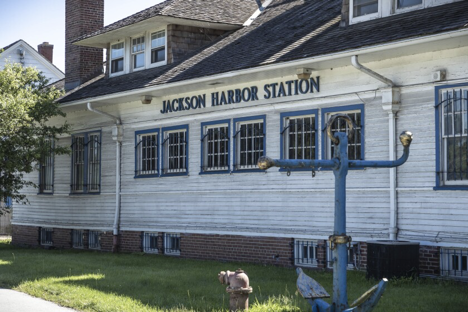
This building served as a Coast Guard station from 1902 to 1963, when the military branch passed it down to the Chicago Park District. After a fire in 1988, the structure was rebuilt and rehabbed, then opened in 1993 as a maritime museum and restaurant. That didn’t last, and now boats that utilize the harbor use the house as a fuel dock.


63rd Street Beach Pavilion, 6300 S. DuSable Lake Shore Drive

The 63rd Street Beach Pavilion at 6300 S. DuSable Lake Shore Drive.

K’Von Jackson for WBEZ

This grand classical beach house was built in 1919 but had been talked about since the 1890s, when Frederick Law Olmsted designed Jackson Park and wanted it to have a spectacular lakefront beach. The park district’s in-house architects are credited with designing the beach house. Though the structure doesn’t get much use these days, it’s handsome and monumental.


Powhatan, 4950 S. Chicago Beach Drive

The Powhatan is part of the Indian Village neighborhood.

Dennis Rodkin for WBEZ

Although we’re focusing on spots directly on the Lakefront Trail, the Powhatan stands out as an Art Deco tower with multicolored panels running up its façade.


Blue Bridges at 43rd and 41st streets

The 43rd Street Pedestrian Bridge connects East 43rd Street and South Oakenwald Avenue in the Bronzeville neighborhood with the Lakefront Trail.

Pat Nabong/Chicago Sun-Times

This pair of brightly colored, corkscrewing bridges signal a significant change in city leaders’ treatment of the South Side. During the 20th century, pedestrians had little direct access to Lake Michigan between McCormick Place and Hyde Park — especially compared to North Side residents, as former Chicago Tribune architecture critic Blair Kamin pointed out in 1998.

The bridges — opened at 41st Street in 2019 and 43rd Street in 2023 — are two very visible pieces of the remedy.


Eugene Williams Memorial, 2900 S. DuSable Lake Shore Drive

The Eugene Williams Memorial.

K’Von Jackson for WBEZ

Chicago’s searing 1919 race riots started here when a group of Black kids on a raft accidentally drifted into a section of the water meant only for white people. One of those kids, 17-year-old Eugene Williams, drowned after getting hit with a rock. His memorial is a small boulder with a plaque. The stone sits between two concrete sidewalks coming in from the lakefront to form a “V.”


McCormick Place Lakeside Center, 2301 S. Martin Luther King Drive

The McCormick Place Lakeside Center behind the McCormick Place Bird Sanctuary.

Pat Nabong/Chicago Sun-Times

McCormick Place Lakeside Center, the behemoth black component of Chicago’s convention center, starts the zone of giants along the lakefront path approaching downtown. Completed in 1971 with a 19-acre roof, the Lakeside Center replaced a 1960 building that burned. This colossus has an architectural pedigree: Mies van der Rohe’s right-hand man, Gene Summers, and famous modern Chicago architect Helmut Jahn designed the building.


Soldier Field, 1410 Special Olympics Drive

An aerial view of Soldier Field looking north toward the Chicago skyline.

Brian Ernst/Chicago Sun-Times

One could write a dissertation or two on the architectural history of Soldier Field, but because future chapters are being written right now, let’s leave it at this: The original war memorial stadium wrapped in columns opened in 1924, and the renovation that made it look like a cruise ship had crashed ashore opened in 2003.


Queen’s Landing, 500 S. DuSable Lake Shore Drive

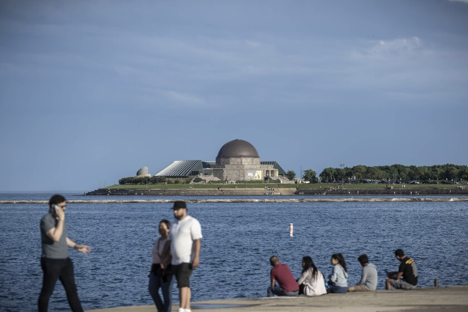
Queen’s Landing with the Adler Planetarium seen in the background.

K’Von Jackson for WBEZ

Not much but concrete marks a visit by English royalty to Chicago. The wide plaza along the Lakefront Trail sits across the street from Buckingham Fountain. In 1959, Queen Elizabeth and her husband, Prince Philip, arrived for a 13-hour stay in Chicago after cruising down the recently completed St. Lawrence Seaway.


Columbia Yacht Club, 111 N. DuSable Lake Shore Drive


The Columbia Yacht Club ice breaker in DuSable Harbor.

Manuel Martinez/WBEZ

That big ship anchored beside the Lakefront Trail has been there since 1983, when the decommissioned ice-breaker and ferry from Nova Scotia was rehabbed into the Columbia Yacht Club. Built in 1947 and called the Abegweit, the boat could break three feet of solid ice.


Bridge over the Chicago River


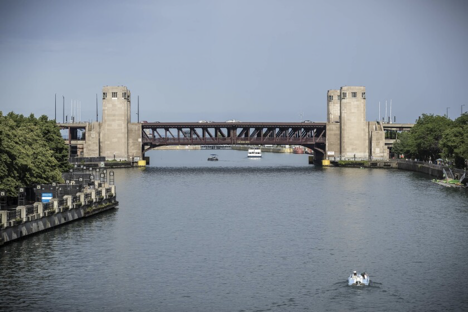
Also called the FDR MemorialBridge, you cross the bridge, you pass through two brief tunnels. In 2020, they were cut into the bridge’s two limestone towers, built in 1937 to expand the space given to bicyclists and pedestrians. The change can be called a return to form: The bridge was initially built starting in 1929 not as a highway but to connect the lakefront parks north and south of the river.


Navy Pier Flyover


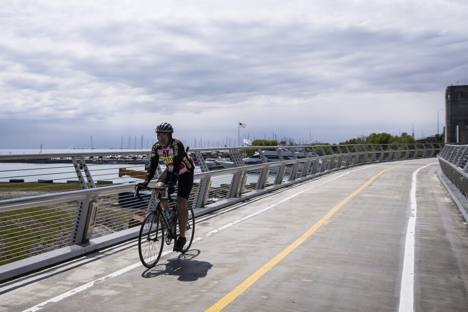
The tunnels were part of the larger Navy Pier Flyover project, which took years and millions of dollars more than originally planned. But all that is forgiven because the structure serves as one of the best and most-needed pieces of bike infrastructure in the city.