Tuesday, November 9, 2021

4Race: Lesson 4b; Social Construction of Race (Continued); The Changing Definition of Whiteness

As we wait for students, please choose one of the readings below and open it in a new window.  Read it now and look for how "race" or whiteness has changed over time.

Changing Definitions of Whiteness
Here are some sociology readings about how different groups have changed over time:
White Americans, the New Minority?: Non-Blacks and the Ever-Expanding Boundaries of Whiteness.  Journal of Black Studies.  1997.  Jonathan W. Warren and France Winddance Twine, sociologists.  From the article,  


All of these are examples of how race has changed over the years in America.  Who is considered white changes because there is no empirical or objective way to define race.  Race doesn't exist in any biological or empirical sense, it only exists as a social construction.

Google Form Here
After reading, answer individually :
1.  What are the factors that affected racial identity in the article that you read?  Cite both the racial identity affected and the factors that contributed.
2.  How did racial identity change over time?  Was this ingroup identity or outgroup identity that changed?

After discussing 1and 2, answer 3 and 4 using the discussion:
3.  Is it surprising that the idea of who is white has changed so much over the years?  Which group is most surprising to hear about?  

4.  What do the articles highlight that demonstrate similarities and differences in racial identity formation in the US between different races?  What conclusions can we make from a critical discussion of all the articles?  

Tuesday, November 2, 2021

Monday, October 25, 2021

Chicago Demolished Buildings: Englewood, Disinvestment and Displacement

 From Block Club,

A Sociologist Photographed 100 Chicago Buildings Just Before They Were Torn Down. What Happened To The Sites 10 Years Later?
    David Schalliol found empty lots where South and West side buildings were demolished and developments in place of demolished North Side buildings.CHICAGO — A historical two-flat in North Lawndale is now a vacant lot. So is a former check cashing store in Englewood. Three homes in Lincoln Park have combined into one mansion. 
The contrast of then-and-now — and how location plays a leading role — is part of a photo project named “After Demolition,” which shows what became of 100 Chicago buildings 10 years after they were torn down. The project is from David Schalliol, a sociology professor at St. Olaf College in Minnesota.
    Schalliol found nearly every demolished North Side building he’d photographed had been replaced within 10 years, while most on the South and West sides were left as vacant lots. 
    Redevelopment was swift in predominantly white neighborhoods, while it was almost nonexistent in others, Schalliol said. Chicago’s infrastructure “continues to be defined by structural racism,” Schalliol said. 
    “Divestment, both public and private, have produced these outcomes and vacancies, which hurt neighborhoods of color,” Schalliol said. “On the North Side, we see buildings that were perfectly fine demolished to make way for new ones. On the West and South sides, buildings are demolished when it’s the last resort.”Schalliol was a grad student at University of Chicago in 2012 when he became interested in demolition as the United States grappled with the aftermath of the housing crash. In the mornings, he’d checked the city’s emergency demolition records, hop in his Volvo and “race out to the building before it was too late” to take a photo, Schalliol said. 
    Most North Side buildings were sold before they were demolished, such as three homes at 1951, 1957 and 1959 N. Orchard St., which became a bigger home at 1951 N. Orchard St., Schalliol said. Many others were torn down to expand neighboring homeowners’ side yards. A former stone church at 834 W. Armitage Ave. was turned into a Walgreens with glass windows from top to bottom.


From After Demolition, a photo essay.

In 2012, I photographed one hundred Chicago buildings destined to be demolished. This summer—ten years later—I returned to document what had changed at each of those building sites. Tragically, the results are as expected. In the past decade, nearly 90% of the buildings located around the Loop and on the North Side of the city have been replaced with another building, while approximately 90% of the buildings on the South and West Sides are now a derelict lot. 
    The idea behind this project, which was published in real time by the webzine Gapers Block as To be Demolished, was to highlight the literal erasure of the city’s built heritage and provide a framework to understand the consequences of the city’s policy-driven demolitions, the still spiraling effects of the Great Recession’s foreclosure crisis, and the demolition by neglect caused so many landlords. I would do so by drawing from public records, including demolition permits, inspection results, publicized developer plans, 311 call records, and other data. In practice, more than a third of the days in 2012, I would wake up, check the demolition permits, and then race to photograph a former home, church, or business before it was demolished. In the process, I also built relationships that resulted in the film The Area, which documented the intentional dismantling of an Englewood community to make way for the expansion of Norfolk Southern’s 47th Street intermodal terminal. Including the hundreds of families displaced and many homes demolished by the train company would increase this project by dozens. And, of course, there were hundreds more buildings I couldn’t reach in time.
    While it was impossible to create a truly random sample because the demolition permits were inconsistently added to the city’s database, an irrefutable pattern quickly emerged: buildings on the North Side were largely being demolished to make way for another structure, while those on the South and West Sides were not. The immediate economic, social, and racial inequities were clear: whiter, wealthier neighborhoods were getting development, while poorer neighborhoods of color were not. 
    From the beginning, I planned to rephotograph these sites ten years later. After all, it is one thing if the demolition of a building leads to the construction of a family’s new house, high-quality affordable housing, or a community garden, but it is something else altogether if the building becomes just another gap in the city’s physical and social fabric, uninhabitable and unmaintained. Pulling together permits, funding, and more means that it may take a long time to create a new structure where one previously stood. Ten years should be enough time. 
    Was it?


From The Area, A South Side Chicago community’s five-year fight for respect in the face of displacement.

Inside the Englewood neighborhood on the South Side of Chicago is a small middle-class community surrounded by railroad tracks. “The area” was a destination for many Black Americans arriving from the South during the Great Migration of the mid-20th century. Homes, wealth, and memories have been handed down from generation to generation.

Despite decades of redlining, divestment, and the 2007 foreclosure crisis, nearly half of families own their homes outright—but the expansion of the nearby freight yard threatens the community and all it has built.

When the train company representatives told Deborah Payne that her South Side Chicago neighborhood would be demolished to build a freight yard, she vowed to be “the last house standing.” A thirty-year resident of the Englewood community, she had raised generations of neighborhood children alongside her own, forging deep friendships and traditions in this Black American community surrounded by the tracks.

The Area is the five-year odyssey of her neighborhood, where more than 400 Black American families are being displaced by a multi-billion dollar freight company. As their community is literally being torn apart, residents maintain friendships and traditions while fighting for the respect they deserve. Through their experiences, the film weaves an all-too-real story about the disproportionate harm that structural racism has done to Black communities, while illustrating the hope and promise neighbors find in one another as they fight for their home.

For more information about The Area, please visit theareafilm.com.


Monday, October 18, 2021

Performance event 3

Directions:

  • Please choose 3 of the prompts below based on the choices that I give you.  
  • Be sure to FULLY answer each question - use the bullet points to be sure that your answer is complete.
  • Use proper grammar, punctuation and spelling.  
  • If you are missing evidence from either units 1 or 2, it is to your benefit to do it now.
  • Remember that you have access to the entire web including my blog! Use it if necessary.  My blog has both a search bar (top left) and a chronology (right side menu).

Per 4 Per 5 Per 7  

3.5 Social (ization) Media

1.  Before starting, what social media accounts do you have?

The rise of Social Media as a Socialization Agent
For decades, television was a dominant force of socialization.  Myriad research shows how dominant television, especially advertising has been and you can see more at this older post of mine here.  However, over the last 10 years, online social media has increasingly played an incredible role in influencing people.  For our next agent of socialization, we will examine social media and its role in socializing people.

Social media arguably has both positive and negative effects on society.  Whether you want to focus on either of those, it is clear that social media has had a transformational effect on American society and it is a strong agent of socialization.


Positive Effects
One of the positive effects of social media is detailed in this research by Miller, et. al. about how social media provides an outlet for non-whites experiencing racial discrimination.  From the introduction (full article here),
Racial coping can be understood through three main approaches: racial and ethnic identity development, social support, and confrontation and anger expression (Brondolo et al. 2009). We argue that social media allow these approaches to be carried on in the online sphere as a way to cope with both online and offline forms of discrimination. Thus, social media can be a site of expression for racial identity, a place where Black Americans and other communities come together to air grievances, seek support, and denounce those who oppress them. This is exactly what drives our research question: do those who experience higher levels of discrimination use more social media?

We argue that social media may be an additional outlet for coping with the negative effects of racial discrimination, as social media allows all aforementioned forms of coping, racial and ethnic identity development, social support, and confrontation and anger expression.
2.  Not all aspects of social media are dysfunctional.  What are some of the ways that social media has played a role in shaping you positively?  Are there any online communities that are supportive of your own sense of self?


Anti-Social Media

Felmlee and Faris published Toxic Ties; Networks of Friendship, Dating and Cyber Victimization in Social Psychology Quarterly (2016) about the ways that social media can strain relationships among friends and dating partners.  LGBTQ teens are most at risk followed by females then males.


Social Media Usage
Open this link and think about what is true for you.


3. Which of the findings in the links above are true for you?


Social Media Used for "News"
A 2021 PEW study showing social media use and news.  


More Americans get news on social media than from print newspapers. In 2018, one-in-five adults said they often get news on social media. And Facebook continues to dominate as the most common social media site used for news by Americans: About four-in-ten Americans (43%) get news on this site.  


4.  Which of the platforms in the graph above do you often get your news from?


The growing trend of getting news online is particularly concerning because a 2020 study found that:

Americans Who Mainly Get Their News on Social Media Are Less Engaged, Less Knowledgeable

Those who rely on social media for news are less likely to get the facts right about the coronavirus and politics and more likely to hear some unproven claims.


Social media users were the second most likely group to have low political knowledge.

Social media users were more likely to have heard 
conspiracy theories about the pandemic.


Social Media and You 

Have you ever stopped to think about what social media knows about you?  Think about the last time you bought something at a store.  If the salesperson was a stranger, would you tell them everything that your social media knows about you?  Look at this post from Tech News and the chart that they included from clario (below):


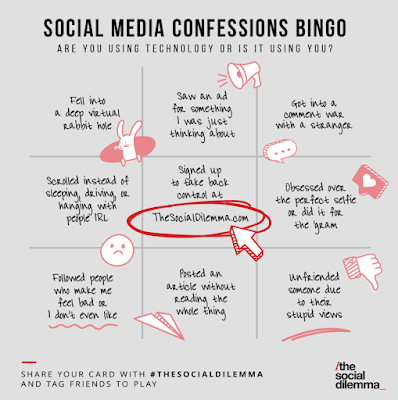
Social Media Bingo


How does this happen?  


The Social Dilemma
A 2020 documentary called The Social Dilemma (available on Netflix) details the influence of social media.  

(TEACHERS NOTE: There is a free and easy-to-use accessibility solution available now for educators who register their event on our website. Since you may have already registered an event(s) in the past few months, we’re linking directly to the Educator Resources document that includes details on how to access the film. When you plan to screen the film again, please re-register your event to receive permission and an up-to-date password for the screening link, which changes frequently.)
Film Summary
The Social Dilemma is a 2020 American docudrama that explores the rise of social media and the damage it has caused to society, focusing on its exploitation of its users for financial gain through surveillance capitalism and data mining, how its design is meant to nurture an addiction, its use in politics, its effect on mental health (including the mental health of adolescents and rising teen suicide rates), and its role in spreading conspiracy theories such as Pizzagate and aiding groups such as flat-earthers.

A Note About Film Structure
There are three distinct settings in the documentary:
  • Real people from tech industry discussing social media and their first-hand knowledge/experience.
  • A drama used to show an average family and how social media affects them.
  • A dark room with three people which simulates the artificial intelligence at play behind the scenes.

Resources 
Here is the website for the documentary.

Here is a full unedited transcript of the documentary from the website scraps from the loft, but I also edited down the full transcript to highlight the parts that I felt were the most important.  You can see my edited version in 4 parts:


  • The documentary was made by dozens of tech executives who have expressed concern about the influence of social media.  
  • The documentary is interspersed with a docudrama that shows how social media is in the background shaping the lives of one family.

The beginning of the movie raises the question, "What is the problem?"
Jaron Lanier explains that,
it is not just that, "we are the product and that our attention is the product being sold to advertisers.  That's a little too simplistic.  It is the gradual, slight, imperceptible change in your own behavior and perception that is the product.  And that is the product.  That is the only possible product...."


Monday, October 11, 2021

Sunday, September 19, 2021

2SocResearch 5: Lifeboat Data and Macro and Micro Soc

HW: Read Joel Charon's Should We Generalize?

Here are the results of 20 years of doing this activity:

Out of 71 times, here are the totals:

1.Able-Bodied Sailor Jones:                                    22
2.Ship’s Officer O’Maley:  Mr./Ms. O’Malley:         2
3.Quarter Master MacDonald:                                 56
4.Self-Made Millionaire Douglas:                           54
5.College Student Mr/Ms Parsons:                          60
6.Nobel Prize Winner in Literature, Dr. Lightfoot   35
7.Nobel Prize Winner in Physics, Dr. Singleton        0
8.Football Player Mr. Small:                                    15
9.Cheerleader Mrs. Small:                                         6
10.Army Captain Thomas:                                       15
11.Draft Evader Samuels:                                        59
12.Peace Corps Volunteer Mr./Ms. Davidson:          5
13.Med Student Mr./Ms. Ryan:                                 0
14.Elderly man Mr. Eldridge:                                  65
15.Elderly woman Mrs. Eldridge:                            62
16.Travelling Poet Mr/Ms Carpenter:                      41


Sociological Literacy:  macrosociology and microsociology.

The activity helps to understand the different levels of study that sociologists examine:  macrosociology and microsociology.

Macrosociological perspective

On the macro level, sociologists look for the influences of large-scale forces on groups or individuals.   So, for the simulation, let's examine the similarities for who your class kicked off the boat compared to the other classes that I have taught.  


Our class is made up of different people than my other classes.  In fact, so different that students are from a different generation!  For example, I have been doing this activity long enough that two of my students married!  They met in my class as the football player and cheerleader, and then after continuing to date during college, they asked me to marry them!  Even though they are old enough to be a different generation than my current class, patterns still emerge.


Class Discussion:  Despite the differences, what does our class share in common with all of the other classes that I have done this with?


Students in our class are Americans, teenagers, high-schoolers, from an upper-middle class suburb. All of these groups have an effect on an individual so that even when an individual makes choices alone, he/she is still being influenced by these groups. 

Students consistently save the characters who they believe are useful, especially the medical student and the Nobel prize winner in Physics.  And, students consistently reject the elderly and the sick (quartermaster, college student) and the draft evader.  There are macro-sociological forces that shape these decisions. All of those participating in this simulation are Americans and teens.  I believe they are shaped by cultural values.   Other cultures might save the elderly or save the more educated or save the sick and the weak, etc...

From a structural-functional paradigm, this macro analysis might focus on the ways that our families, schools, economy and peers all promote the values that the macro data reveal.

From a conflict paradigm, this macro analysis might focus on who consistently is treated differently by the macro data and the ways that those people are affected by that treatment.

Microsociology
On the microsociological level, sociologists study how groups interact in face-to-face conversation. That is, who makes eye contact, how loud people speak, where they sit, who is the leader, etc... So, the microdata from each time that the activity is done, might be different based on the interaction.  This includes the words students use.  This can be an example of the symbolic interaction paradigm.  Because there is shared meaning in some of these words, that shapes how people react.  For example, if the poet focuses on being a poet, people might see that as undesirable and kick him off.  But if the poet reinforces that he is useful because of his sailing skills, that might save him because usefulness is a shared value in our culture. 


This activity is a metaphor for any group that you are a part of; all of the groups that shape you are governed by both macro-sociological forces and micro-sociological forces.  For example, apply this to high school.  If we examined these two levels in high school, there are certain macro-sociological values that one would expect to find no matter where the school is located: grades, expectations of learning, homework, rules etc... So as you move from one class to the next, you will see these macro-sociological values present. On the other hand, every class is different because of the micro-sociological dynamics present in that class: some teachers are more casual, some teachers use rows vs. a horseshoe shape, some classes have a few loud boisterous individuals and other classes might be mostly girls or mostly guys etc...


These questions are continued from the Google Form from the previous lesson:

Sociological Literacy:  Macro and Micro Sociology and Statuses
4.  What does macro-sociology focus on?


Small Group Discussion (don't write this down, yet)
5. How would a sociologist examine this activity using macro-sociology? 


6.  What does micro-sociology focus on?


7. How would a sociologist examine this activity using micro-sociology?


Individually Applying Sociology:
8.  Apply this to the primary research article that you found.  Is the research that you found,  macro or micro? Why?


Can you see these two levels at play in your own life? Perhaps in your family, your classes or with a group of friends, or at your job? Think about that lifeboat activity and how it is a metaphor for any of the groups that you are a part of. There are macro forces like culture and social class that affect your group but there are also micro forces at play too such as the dynamic of how the group interacts.


Sociological Literacy Review:

Social Construction of Reality
How can you examine this activity using the idea of social construction of reality? 
Sociological Imagination
How can you examine this activity using a sociological imagination?