Monday, August 14, 2017

Day 2: You came back! What's in a name? (Hint: Use your sociological imagination)

Thanks for coming back to sociology and giving me more chance! :-)

As your classmates enter the room, 

1.  Please take out the packet from yesterday, read through the syllabus and let me know if you have any questions.

2. Turn to the back page of your packet and find the "Student Info" sheet.


Take out Target Takeaway sheet.  
The TT sheet is a summary of the skills that I want you to take away from the class. 


What's your name and its origin?

What is your legal name given at birth?

How did you get this name?  Why do you think you are named this?

What is the name you prefer to be called?

How did you get this nickname?  When and why did you start using this name?

Individuality or connection to community?
Your name is one of the first pieces of your identity.  It is what you learn to respond to and what you call yourself.  It seems to be an example and expression of your individuality, however, it is an excellent example of how individuals are really not separate from community.  Instead, each of us is shaped by community.

Your name is personal and it has a unique and specific genesis.   However, the story of how you got your name is a story of connection and dependence on others.  You did not choose your name, it was given to you.  It was the beginning of your socialization, the influence of society on who you are.  Sociologist Nathan Palmer describes the social influence on naming babies in his post at Sociology Source;
What emerges from this naming process is a trend. Many names go in and out of fashion; trending up in popularity and then back down. An easy way of illustrating this to your students is to use the US Social Security Administration’s “Popular Baby Names” database. This easy to use website allows you to search any name and see how it ranks against the 1000 most popular baby names. For most students their names go from out of fashion in the decades before their birth, then they become popular right around their birth, and then fall out of popularity again.


So, the seemingly individual decision parents make for their kids, is not an isolated decision.  Many parents are influenced to name their kids based on names that are trending (even though parents don't realize the name is trending).

Examine the name data:

Click here to see the Social Security Administration's baby name database (pictured at left).  It details the top 1000 baby names for boys and girls for the last 100 years.  After you click the SSA link above, enter your name and change the search to "1900 & later" and click "GO" to lookup your birth name.


6. Does it show up in the database?

7.  What year was the most popular year for your name?


8.1  Now search the database for different patterns.  Identify at least one pattern.  Some ideas you might consider:  choose a name and analyze it over time, can compare different years, compare different genders, etc...

Why do these patterns occur?  The U.S. is a very large country ~300 million people!

This article from the NY Times details how names become more and less popular over time.  The article cites the work of sociologist Stanley Lieberson from Harvard.


"...in 1950, 5% of US parents chose a name for their child that wasn't in the top 1,000 names. In 2012, that figure was up to 27%.As late as the 18th Century, it wasn't uncommon for parents to call multiple children the same name - two Johns for different grandfathers, for example. Now parents increasingly look for unique names or spellings of names. As Jean Twenge points out in her book the Narcissism Epidemic, Jasmine now rubs shoulders in naming lists with Jazmine, Jazmyne, Jazzmin, Jazzmine, Jasmina, Jazmyn, Jasmin, and Jasmyn."


So, the first part of this exercise reveals that parents are influenced in different ways to name their kids.  However, as we will see, the name that parents choose also influences the kid.  There has been a host of research detailing the ways that people are influenced by their names.

Effects of names
This lesson from Nathan Palmer on Sociology in Focus explains the importance of having your name pronounced correctly in class, especially by teachers.

What are some ways that having your name mispronounced might affect you?  What are some of the messages that mispronouncing a name might send?

Can the mispronunciation of a name be a small part of a larger message?

This Newshour report from PBS explains more about the importance of pronouncing names correctly.


The American Sociological Association also published a lesson on the Trails Database called "What's in a Name?"   This lesson focuses on the cultural importance of names.  In questions above, if you put a nickname that was more "American" than your original name, why?  Some follow up questions from the professors at UCLA who authored this lesson are:


  • Does altering of a family name to a more “American-sounding” name has any benefits to the individual. Does the alteration of names exemplify assimilation? 
  • Does assimilation has any costs to the individual, such as cultural devaluation and family history.
  • Does anyone whose names has been altered feel any enduring, negative self-perception or shame?
  • Are there any potential benefits to name reclamation?


This BBC article cites two sociologists:  Dalton Conley of NYU and David Figlio of Northwestern University.  Figlio's research shows that siblings may face more or less discrimination by teachers depending on the perceived social class and race of their names.


Here is additional research about names:

Business Insider, "13 Surprising Ways Your Name Affects Your Success."

Science Focus, "Name Game; How Names Spell Success in Life and Love."

Live Science, "Good or Bad, Baby Names Have Long-Lasting Effects."

New Yorker, "Why Your Name Matters."

Freakonomics podcast "How Much Does Your Name Matter?"

Takeaway:

Most importantly, I want to learn and pronounce your name correctly.  And, I would like you all to do that for each other.

Secondly, however, this introduction to you, also introduces us to sociology:

  1. Sociologists use research to understand the influence of society on individuals such as interviews and existing sources.
  2. Individuals are shaped by social institutions such as education and family.  These institutions provide structure that influences individuals.  
  3. Sociologists often focus on inequalities in society such as discrimination based on culture, gender, race and social class.  Sometimes this discrimination is institutional and so it might go unnoticed.
  4. Finally, sociologists study the shared meaning between individuals.


Sunday, August 13, 2017

Day1: Welcome to Sociology!


HW: Please interview some family members how and why you have the name that you have.  How did you get your legal name?  If you prefer being called a nickname, then ask about that as well.  How did you get that nickname?


As the first day began, I said, "Let's get started."
Then, we sat in silence.  Sitting in silence was awkward and unusual for most of us. Some students felt the need to fill the silence with a comment or a joke.  Clearly, this is not the way most of us are used to beginning a class, especially the first one of the semester.

Answer question 1: What’s happening here? What are all of the thoughts that came to mind as I sat here in silence?

Sociology of silence
I like beginning the semester like this for two reasons.  First, I use this to show that most students already think sociologically, albeit in a simplified manner.  Sociologists analyze groups of people and how the people are shaped by the groups of which they are a part.  You have been a part of dozens of classes over the years.  You have seen firsthand how these classes begin every semester.  Nearly every class you have been in has started with the teacher standing in front of you and saying this is what you should or shouldn't do, etc... From participating in all of these first classes, you have begun to expect certain things from them. That is, loosely, what sociologists do; analyze people in groups and look for patterns of behavior and then analyze how those patterns affect people.

Unlearning what you have learned
Secondly, the silence is also a critique of modern education.  Education is a social institution.  Sociologists study institutions and how they affect people.  This critique of education came to me from Bernard McGrane's Book The Un-TV and the 10MPH Car. McGrane makes the case that students have been trained to follow and become good at school - but not at learning. Their curiosity and excitement for learning has been squashed by a system that rewards docility and conformity. Rather than taking initiative for their own learning, students expect the teacher to provide them with exactly what they need - "Just tell me what to do," is the attitude.
My class will ask students to engage in the learning; take part in the process. Our class will also ask students to share their own experiences and relate them to sociology.  We all learn from each other. We are all both teacher and student.
Keep a beginner's mind, an empty cup.

Answer questions 2-5:
2.  What is sociology? How does the silence experience exemplify what sociological thinking is?
3.  What am I trying to reveal about education by doing the silence experiment?
4.  If students are not passive, how should they be active?  What does good class discussion look like?
5.  What do you think the most important qualities would be for someone working at Google?

Discussing Discussion.
If students should not be passive, then what should class look like?  This post from the Everyday sociology blog explains the best way to learn new concepts.  

It might surprise you to find out what the qualities are that Google now looks for in it's managers and leaders.  And the cool part about it is that Google hired researchers with a background in social science (sociology) to help them improve.
"...the best teams at Google exhibit a range of soft skills: equality, generosity, curiosity toward the ideas of your teammates, empathy, and emotional intelligence. And topping the list: emotional safety. No bullying. To succeed, each and every team member must feel confident speaking up and making mistakes. They must know they are being heard."
My class will demand that you exhibit these skills that researchers identified.  It will demand that you are active.  You cannot hide quietly in class and you cannot rely on a test to pass the class.

Course Syllabus
Download the course syllabus here.  Note these important aspects of the syllabus:
Be open, present and prepared.  
There is a mandatory final research paper regardless of whether you have an A- or not.

Other impacts of silence.
What are the other ways we have learned to be silent and passive?

Checkout teacher Clint Smith speaking at a TED Talk about silence.  It is often our own silences that speak louder than our words.  This is especially true in a culture that teaches you to be a follower; to sit down and shut up and conform.  Watch that video.  
Think about the speaker's message.  I want you to find your voice.  To learn who you are as a person and to learn to speak up for what you believe in in an educated and meaningful way.

A Little boy and an Old Man.
Finally, let me tell you a story about a little boy and an old man.  That story, adapted from a Nepalese tale is here.

Self Assessment

Here are the class expectations for participation.  Each week I will ask you to reflect on your participation in the class.  Have you been open, present and prepared?

Takeaway

Literacy/Concepts:
Sociology
Institutions

Conclusions/Inquiry:
What is your first impression of sociology?
What do you think about the awkward silence?
Do you see how we set expectations based on our experiences?
Did you know what sociologists studied before taking this class?
Do you realize that students expect the teacher to tell them what to do?
Can you see how this crushes a love for learning?
What are subjects/topics you think would be interesting to study in sociology?

Monday, August 7, 2017

Data from US Census

Here is a link to all of the data available at Census.gov:
https://www.census.gov/schools/resources/data-tools.html


Here are activities specific to sociology:
https://www.census.gov/schools/activities/sociology.html


Here are teacher suggestions for using Census data:
https://www.census.gov/programs-surveys/sis/about/teachers-guide.html

Sunday, August 6, 2017

Data from Pew Research Center

Pew has reports on different subjects including social trends.

http://www.pewresearch.org/

Friday, August 4, 2017

Data from Teaching with data.org

http://www.teachingwithdata.org/

TeachingWithData.org is a portal where faculty can find resources and ideas to reduce the challenges of bringing real data into post-secondary classes. Using real data is a great way for students to become more engaged in the content of a course, but significant barriers, largely in terms instructor preparation, exist that can make using data a challenge. TeachingWithData.org allows faculty to introduce and build students' quantitative reasoning abilities with readily available, user-friendly, data-driven teaching materials. Including data early and often throughout the curriculum not only allows students to practice quantitative skills such as reading tables or translating numbers into graphs or charts, but their interest in and understanding of course material can be piqued by the excitement of doing empirical work. Additionally, opportunities to see how social scientists examine issues and draw conclusions should lessen the disconnect many students experience between substantive and methods/statistics courses. with the content of a course, to experience the work of social scientists, and strengthen valuable skills that will useful in everyday life, even if they do not take another social science course.
TeachingWithData.org is a partnership between the Inter-university Consortium for Political and Social Research (ICPSR) and the Social Science Data Analysis Network (SSDAN), both at the University of Michigan. The project is funded by NSF Award 0840642, George Alter (ICPSR), PI and William Frey (SSDAN), co-PI.

Data from Gephi; Social Networking data visualizer

https://gephi.org/

Gephi is a tool for data analysts and scientists keen to explore and understand graphs. Like Photoshop™ but for graph data, the user interacts with the representation, manipulate the structures, shapes and colors to reveal hidden patterns. The goal is to help data analysts to make hypothesis, intuitively discover patterns, isolate structure singularities or faults during data sourcing. It is a complementary tool to traditional statistics, as visual thinking with interactive interfaces is now recognized to facilitate reasoning. This is a software for Exploratory Data Analysis, a paradigm appeared in the Visual Analytics field of research.


From http://sna433.weebly.com/network-analysis.html:
I learned 3 major things from visualizing and analyzing my  social network:1. I have a few important central nodes and connectors. For example, I have 68 common friends with my best friend2. I have a large community of UBC friends and smaller communities within this network. For example, I have friends from Jump Start (leadership program for 1st year intl students), friends I know from Marine Drive, classmates, UBC clubs and other communities within my large UBC cluster.
3. This graph helped me to easily detect outliers and people I don't have close connections with (Perhaps, I know how to easily clean my Facebook friends now?)


From http://forum-gephi.org/viewtopic.php?t=5905 :

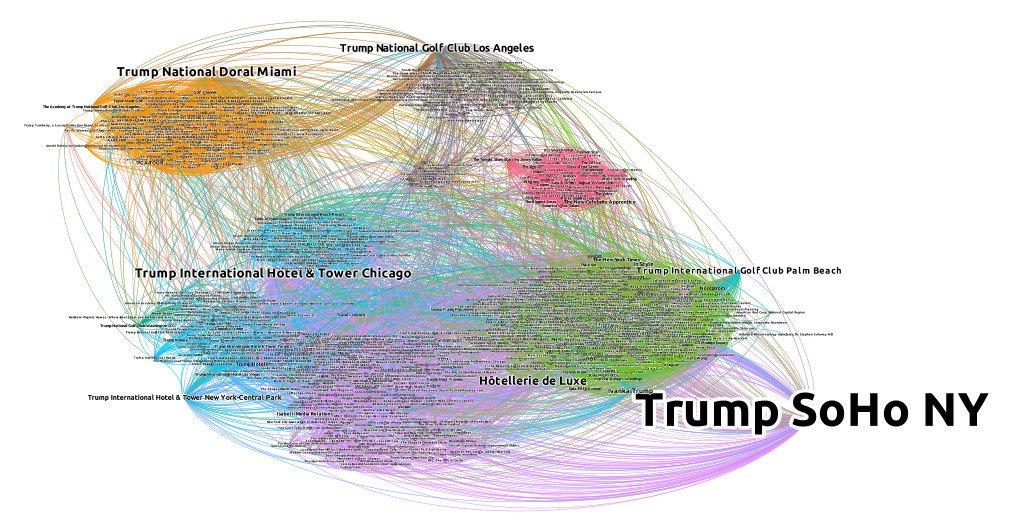
this is a graph i made yesterday with the network of facebook pages "friends" of Donald Trump.  As you can see, i would like to show some labels, just the most important

Wednesday, August 2, 2017

Data from U of Michigan's Monitoring the Future - Data on Teens and behaviors, attitudes, values

http://www.monitoringthefuture.org/

Monitoring the Future is an ongoing study of the behaviors, attitudes, and values of American secondary school students, college students, and young adults. Each year, a total of approximately 50,000 8th, 10th and 12th grade students are surveyed (12th graders since 1975, and 8th and 10th graders since 1991). In addition, annual follow-up questionnaires are mailed to a sample of each graduating class for a number of years after their initial participation. The Monitoring the Future Study has been funded under a series of investigator-initiated competing research grants from theNational Institute on Drug Abuse, a part of the National Institutes of Health. MTF is conducted at the 
Survey Research Center in theInstitute for Social Research at theUniversity of Michigan.

Monday, July 31, 2017